
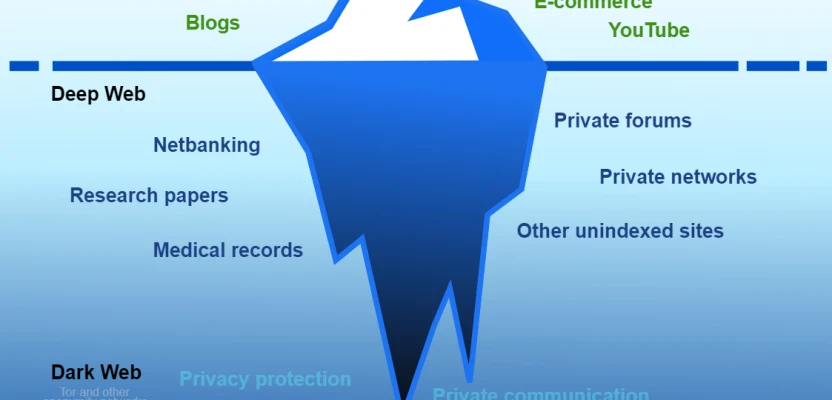
Deep web, dark web, and darknet are three different things, and confusing them leads to almost every misconception about the hidden side of the internet. The deep web is simply the part of the internet that search engines cannot index. The darknet is the underlying network technology that enables anonymous communication. The dark web is the collection of websites and services that run on those networks. Once you separate the layers, the picture becomes much clearer, and far less alarming than headlines suggest.
Why These Terms Keep Getting Mixed Up
Journalists, movies, and even some security vendors use the three phrases interchangeably, which has produced a decade of muddled reporting. A headline about "dark web markets" might actually describe a website hosted on a Tor darknet, or it might loosely refer to any hidden service. That sloppy shorthand is why you will see ordinary private web pages described as "dark" when they are nothing of the kind.
The confusion has a historical cause too. Early coverage of Tor and anonymous networks arrived before the terminology settled, and the dramatic phrase "dark web" proved more quotable than the technically accurate alternatives. Once a label sticks in the public imagination, correcting it is slow work.
What the Deep Web Actually Is
The deep web is every page that Google, Bing, and other crawlers cannot reach: your email inbox, online banking dashboard, medical records portal, paywalled articles, private company intranets, cloud storage folders, and members-only forums. These pages exist on the ordinary internet and load in any normal browser. They are simply protected from indexing, usually behind a login wall, a paywall, or a noindex directive.
Estimates consistently place the deep web at the vast majority of the web's total size, often cited above 90 percent. The overwhelming bulk of that volume is completely mundane: form submissions, database records, dynamic content generated on the fly. Nothing about it requires special software, a VPN, or anonymity. It is hidden from search engines, not hidden from the world.
Researchers have tried to measure the deep web for decades, and the numbers vary wildly because the definition is so broad. Some studies focus on databases reachable through the surface web, others count password-protected pages crawlers cannot authenticate into. The exact figure matters less than the structural fact: what search engines index is the tip of the iceberg, and the submerged portion is mostly routine private data.
Deep Web Versus Surface Web
The surface web, also called the clearnet, is the small slice of content indexed by search engines and reachable through ordinary addresses. Deep web pages use the same infrastructure and the same protocols; they just do not advertise themselves to crawlers. When a bank shows you a balance after you log in, that page is deep web content generated for one specific user.
Because the deep web is ordinary private data, it is also where your most sensitive information lives: password reset pages, account settings, saved documents. That makes it a target, but not because of any inherent darkness. It is simply where the valuable data concentrates.
What a Darknet Is, Technically
A darknet is a network that sits on top of the internet and only accepts connections through specialized software. Instead of the standard DNS and routing model, darknets use their own addressing, discovery, and encryption layers so that participants can communicate without revealing who they are or where they are. Tor, I2P, Freenet, and ZeroNet are all examples of darknets, each built around a different design philosophy.
Tor is by far the largest. It began as a research project at the United States Naval Research Laboratory in the mid-1990s, was released to the public in 2003, and now runs on thousands of volunteer-operated relays serving millions of daily users. The network's purpose was never exclusively illicit: it was designed for privacy research, censorship resistance, and secure communication in hostile environments.
The other darknets occupy different niches. I2P focuses on anonymous peer-to-peer communication with garlic routing instead of onion layers. Freenet prioritizes censorship-resistant publishing where content persists even when hosts go offline. ZeroNet builds decentralized sites on the BitTorrent protocol. None of these networks is inherently criminal; each simply refuses the assumption that every connection should be identifiable by default.
How Tor Onion Routing Works
Tor routes traffic through a chain of three relays, called nodes. Your data is wrapped in multiple layers of encryption, like an onion, and peeled away one layer at each hop. The entry node sees your real IP address but not your destination. The middle node sees neither. The exit node sees the destination but not your identity. No single relay in the chain knows the full picture.
When you visit a Tor hidden service, identified by an address ending in ".onion", the connection never leaves the network at all. Traffic bounces between relays and reaches the destination encrypted end to end, so the server operator cannot learn your location and you cannot learn theirs. This is the mechanism that makes the dark web technically possible.
The Dark Web Defined
The dark web is the content layer: the websites, forums, markets, and services hosted on darknets like Tor. Anything reachable only through Tor Browser or similar tools is dark web content, though calling every Tor site "dark web" is technically imprecise, since Tor is just one of several darknets in existence.
The dark web is therefore a subset of the darknet ecosystem rather than a synonym for it. The darknet is the road network; the dark web is the buildings along it. You cannot have dark web services without a darknet underneath, but a darknet can exist without hosting what people typically mean by the dark web.
Who Uses the Dark Web, and Why
The user base is far more diverse than crime dramas suggest. Journalists use Tor to protect sources and research stories in repressive countries. Activists rely on it where speech is monitored or blocked. Ordinary people use it to keep browsing private from advertisers, ISPs, and governments. Security researchers operate hidden services to study threats. Even some corporate employees route internal tools through anonymity networks.
That said, illicit activity does exist. Hidden markets, fraud forums, and leaked-data dumps are real, and law enforcement regularly conducts takedowns on major markets. The honest framing is that the dark web mirrors the surface web: it contains everything humanity does, including commerce, communication, activism, and crime, because anonymity amplifies whichever behavior is already present.
What Is Actually on the Dark Web
Research into Tor hidden services has found that roughly half appear to engage in illegal commerce or services, which means the other half does something else entirely. Legitimate dark web destinations include whistleblower submission platforms, privacy-focused email and messaging services, censored news publications, academic archives, and developer communities that prefer anonymity.
Illicit destinations include drug and fraud markets, stolen-data shops, hacking forums, and scam operations. The markets that dominated headlines a decade ago have largely been dismantled or migrated, and new ones constantly appear and vanish. Treating the entire space as uniformly criminal is as inaccurate as treating the surface web that way.
Hidden services also include infrastructure that rarely surfaces in casual browsing: command-and-control servers used by malware authors, phishing panels, and ransomware negotiation sites. Security firms monitor these spaces continuously, and coordinated takedowns by law enforcement and researchers have removed some of the largest markets and forums in recent years.
The Limits Nobody Mentions
Anonymity on Tor is a probability, not a guarantee. Timing correlation attacks can deanonymize users when an adversary can observe traffic at both ends of a connection. Confirmation attacks, where an attacker plants identifiable content and watches for its retrieval, have unmasked users before. Users who log into personal accounts, reuse passwords, or enable JavaScript in ways that leak information can undo the network's protections entirely.
The weakest link is almost always the human. A perfectly encrypted channel tells you nothing if you voluntarily identify yourself afterward, download malware, or trust a phishing mirror of a legitimate service. Privacy tools reduce risk; they do not eliminate it.
For most readers, the practical takeaway is narrower than the mythology suggests. You do not need to visit the dark web, and doing so casually adds risk without benefit. If anonymity is genuinely required, use Tor Browser as designed, keep it updated, avoid logging into personal accounts, and treat every downloaded file as hostile until proven otherwise. Understanding what these terms mean is the first step toward engaging with them wisely rather than fearfully.
Frequently Asked Questions
Is the deep web illegal?
No. The deep web is ordinary internet content behind logins and paywalls, and nearly all of it is perfectly legal. Your email account and bank portal are deep web pages. Nothing about being unindexed makes content unlawful.
Is the dark web the same as Tor?
Not exactly. Tor is a darknet, the network layer. The dark web is the collection of services hosted on darknets, and Tor is the most prominent one but not the only one. I2P, Freenet, and others host their own versions of dark web content.
Is browsing the dark web dangerous?
It can be. Threats include malware, phishing, scams, and law enforcement attention if you engage in illegal activity. Simply visiting in a properly configured Tor Browser is relatively low risk, but downloading files or logging into accounts substantially increases exposure.
Do search engines index the dark web?
No. Hidden services are deliberately unreachable from the clearnet, so conventional search engines cannot crawl them. Specialized directories and indexes exist, but they are community-maintained and often unreliable.
Can you be tracked on the dark web?
Tor makes casual tracking very difficult but not impossible. Sophisticated adversaries, compromised endpoints, or careless user behavior can still reveal identity. Assume that determined attackers with resources may succeed eventually.
The takeaway is simple: the deep web is the unindexed bulk of the ordinary internet, darknets are the specialized networks that enable anonymous hosting, and the dark web is the content living on those networks. Three layers, three different answers, and only one of them that deserves the reputation it has.

Comments 0