

Tor's weakest point is not its encryption but its infrastructure: the network depends on thousands of volunteer-operated relays, and several documented attacks—most notably the 2014 'Relay Early' Sybil campaign and the 2020 sslstrip exit-node crisis—showed that a well-resourced attacker can control enough of those relays to threaten anonymity at scale. Understanding how those attacks worked, and how the Tor Project responded, is essential for anyone who relies on onion routing in practice.
Why the Relay Layer Is So Fragile
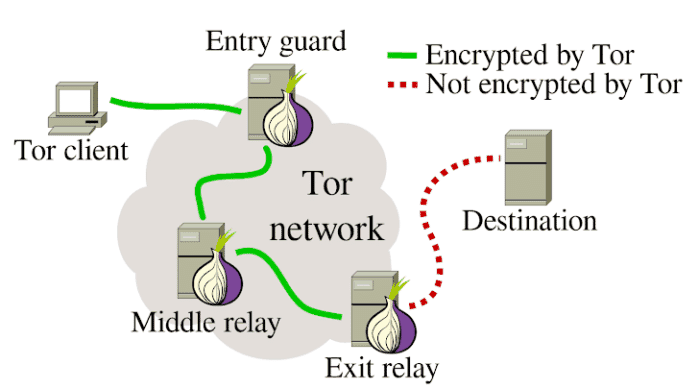
Tor was designed around a simple idea: bounce traffic through three independently operated nodes so no single point can link a user to their destination. That design holds only as long as the relays genuinely belong to unrelated operators. Because anyone can run a relay for free, the network has no way to vouch for who controls a given node. An attacker who spins up hundreds of machines therefore looks, from the protocol's perspective, almost identical to a legitimate enthusiast running a busy server.
This asymmetry is what makes relay-level attacks so dangerous. Onion encryption can be perfect, yet if an adversary controls the first hop or the last hop of too many circuits, the cryptography protects nothing. The code can be flawless while the people and machines around it become the vulnerability.
Position matters enormously in onion routing. A guard relay sees the user's IP address but only encrypted traffic; an exit relay sees plaintext destinations but not the user's identity; a middle relay sees neither end clearly. An attacker who can influence which relays occupy these roles across a large share of circuits can assemble pieces of the anonymity puzzle that no single node could ever reveal.
The 2014 Relay Early Sybil Attack
Beginning around mid-2014, an unidentified operator quietly stood up roughly 115 high-performance relays that together accounted for about 6.4% of the network's guard capacity. For more than five months the relays ran quietly, accruing enough uptime and bandwidth to earn trusted consensus flags and to become entry guards for a substantial fraction of Tor users.
The technique was a traffic-confirmation attack: an active "signal injection" relay sat at one end of a circuit while a passive reading relay watched the other, letting the operator correlate activity and potentially deanonymize hidden services such as .onion websites. Once the Tor Project noticed the unusually synchronized behavior, it published an advisory describing the relays and removed their influence, forcing a reshuffle of guard selections across the network.
The episode also exposed a weakness in how trust was granted. The malicious relays had been fast, stable, and generous with bandwidth—exactly the traits the consensus rewarded. Speed and uptime were treated as proxies for honesty, and a determined operator could game both metrics for months before anyone asked who was behind the machines.
The 2020 sslstrip Exit-Node Crisis
Six years later, a different group demonstrated an even blunter form of relay abuse. During May and June 2020, adversaries controlled approximately 20% of Tor's exit capacity and ran a modified sslstrip tool. Instead of attacking the cryptography, they intercepted users' connections to cryptocurrency exchanges, rewriting HTTPS redirects so victims reached unencrypted pages while still believing they were browsing securely.
The attack worked because Tor browsers expose a warning sign most users ignore: the padlock. When Tor reached roughly 23% exit share, the Tor Project intervened, and investigators later found a second cluster operating around 19% capacity, reportedly pursuing the same scheme. It remains one of the clearest demonstrations that controlling exits alone is enough to profit from Tor traffic without breaking a single layer of encryption.
The 2022 Ghost Relays
The most unsettling case surfaced in 2022, when researchers identified what became known as ghost relays: nodes that had been operating for months or even years while behaving in a completely passive manner. They never injected traffic, never attempted decryption, and showed no visible malicious behavior at all.
Their true purpose was never confirmed, which is precisely what makes them alarming. Dormant infrastructure costs little to maintain and can be activated at the moment an attacker chooses—for instance, during a political crisis or a sensitive investigation. In a volunteer network, the possibility of sleeper nodes cannot be ruled out, only mitigated.
What a Sybil Attacker Is Really Trying to Do
Behind every relay attack sits the same goal: break the assumption that the three hops in a circuit are independent. A Sybil attacker seeks either end of the circuit. Control of a guard lets them observe or inject traffic entering Tor; control of an exit lets them see plaintext leaving it. Control of enough of both enables the traffic-confirmation correlation that deanonymizes users.
Hidden services add a twist. Because .onion addresses are themselves Tor circuits, attackers targeting service operators can try to become both the service's introduction point and the client's guard, narrowing the anonymity set dramatically. The 2014 attack targeted exactly this scenario, which is why hidden-service operators were the first to feel the pressure.
How Tor Fights Back
Tor's defenses are layered and constantly evolving. Nine hard-coded directory authorities must reach unanimous consensus before any network parameter changes, making it nearly impossible for one party to rewrite routing rules unilaterally. New relays start with minimal traffic and must prove stability and good behavior before earning guards or exits.
Routing additionally favors diversity: circuits are built to avoid relays sharing an ASN, IP block, or country where possible, shrinking the odds that one operator controls multiple hops. Automated anomaly detection hunts for identical configurations, synchronized bandwidth patterns, and other fingerprints of coordinated nodes. In 2022 the Tor Project itself conceded it had "invested too little effort" into bad-relay tooling—a candid admission that the arms race never truly ends.
The 2020 sslstrip incident also produced concrete countermeasures: Tor Browser now ships with HTTPS-Only Mode, which refuses to load pages that cannot be encrypted, directly neutralizing the attack's core trick.
The Human Factor Remains the Weakest Link
Every major relay attack ultimately succeeded because of people, not protocols. In 2020, victims ignored the missing padlock and trusted pages that never had HTTPS. Relay operators, meanwhile, are volunteers with varying motives—some run exits for altruism, others for profit, and a determined attacker can blend in either way.
Even well-meaning users contribute risk. Downloading unofficial Tor builds, disabling security features, or running Tor alongside deanonymizing browser extensions each erodes the protections the relay layer provides. The network can survive a compromised relay; it cannot always survive a user who voluntarily hands over their own metadata.
Frequently Asked Questions
Can a single malicious relay deanonymize me?
Not on its own. A single compromised node sees only encrypted traffic passing through it and cannot link you to your destination. The danger arises when one operator controls enough relays to occupy multiple positions across many circuits, which is why Sybil attacks require scale.
Is Tor still safe to use after these attacks?
Yes, provided you use the official Tor Browser and keep it updated. Each incident prompted patches and new defenses—HTTPS-Only Mode, better exit monitoring, and improved consensus rules—and the Tor Project continues to fund active countermeasures. No alternative currently offers the same combination of free access and layered anonymity.
How can I tell if an exit node is malicious?
You cannot identify a specific exit's operator, but you can protect yourself: HTTPS-Only Mode prevents unencrypted interception, and checking that the padlock remains valid after redirects defeats sslstrip-style attacks. Avoid entering credentials on any page that fails to load over HTTPS.
Why doesn't Tor verify its relay operators?
Verification would require identity documents or centralized vetting, which would destroy the anonymity the network exists to provide and centralize a system designed to have no trusted party. Instead, Tor relies on economic and statistical defenses: making malicious operation expensive, detectable, and ultimately unprofitable.
Tor's relay layer has absorbed every attack thrown at it so far, but its survival depends on continued vigilance from both the project and its users. The network's real strength was never the code alone—it is the collective effort to keep a volunteer infrastructure honest, diverse, and difficult to corrupt.

Comments 0