
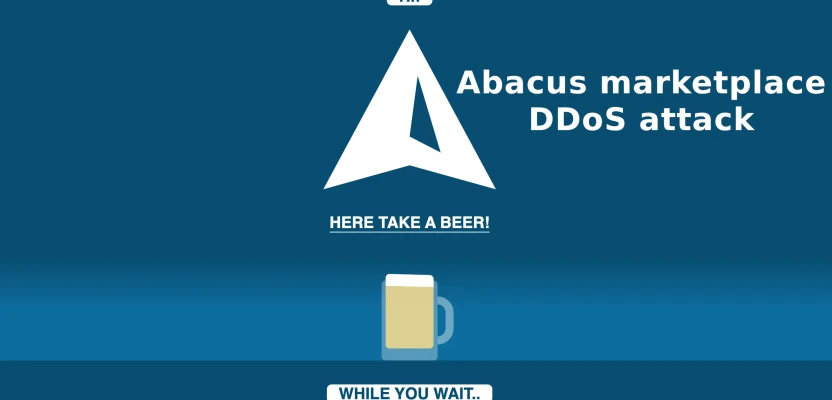
Mid-2025 produced a moment that darknet observers will likely point back to for years: instead of operating quietly in the shadows, rival groups on the black market stage began a feud in the open. A member of Breaking Bad Forum chose Abacus Marketplace as a target, announced the intention publicly, and turned the conflict into something closer to a spectator event than a covert act. What followed was not a single blackout but a sustained campaign: repeated distributed denial-of-service attacks that pushed one of the network's remaining heavyweight platforms into hours of silence, froze buyer funds, drove vendors toward rival markets, and exposed just how fragile darknet infrastructure had become.
The Public Ultimatum
Darknet disputes have historically been fought through anonymous threats, exit scams, and quiet sabotage. The Breaking Bad post broke that pattern. A forum user identified as Faraday wrote a short, unapologetic message on June 14 declaring that Abacus would be next, with the marketplace effectively invited to respond or accept its fate. The phrasing was casual, almost sporting, yet the implication was unmistakable: a forum with a large criminal readership was pointing at a trading platform and promising action.
Community reaction arrived immediately. Threads filled with members speculating about timing, estimating how long Abacus could endure, and treating the marketplace like an entry in a betting pool. Whether the post was genuine coordination or bravado matters less than what it signaled: the taboo against naming targets openly had eroded. For vendors who had built their reputation on Abacus, the message was a warning that reputation alone would not shield them.
The First Wave Hits
Eleven days after the announcement, on June 25, the campaign began. Abacus's primary domain and its backup mirrors stopped responding within a matter of minutes, a pattern consistent with an overwhelming flood of traffic aimed at knocking out every known point of access at once. Mirror redundancy, normally a defensive strength, offered no protection when the entire set of entry points was saturated simultaneously.
Recovery efforts stretched across roughly twelve hours of continuous outage. During that window, sellers reported transactions stalling mid-flow while buyers found themselves locked out of account balances and open orders. The technical sophistication of the attack drew particular attention: traffic volumes alone could not explain the speed of the collapse, suggesting botnet coordination and DNS amplification techniques that exceeded the defenses marketplace operators typically deploy.
Operators attempted the standard playbook — routing traffic through protection layers, rotating domains, pushing cached pages — but each workaround was met with updated targeting. The lesson was uncomfortable: for a platform whose entire customer base depends on reliable reachability, being unreachable even briefly is functionally equivalent to being shut down entirely.
An Unexpected Casualty
The disruption reached beyond Abacus itself. Around the same period, the Dread forum — a widely used review and discussion hub that most of the underground treated as neutral ground — experienced its own outage at nearly the same moment. The coincidence sent speculation rippling through the community: either the attackers had deliberately broadened the strike to forums associated with market oversight, or the platforms shared infrastructure components whose failure cascaded across both.
Either explanation alarmed different audiences for different reasons. If the outages were linked, then operational security on one platform could compromise another, undermining the compartmentalization darknet users rely upon. If the attacks were unrelated, the simultaneous timing still implied either extraordinary coincidence or deliberate misdirection. For a community that prizes discretion above all else, losing the ability to assume independence between platforms was a serious psychological blow.
The incident also raised questions about forum reliability as a trust anchor. Review hubs derive their value from being available precisely when traders need to check a vendor or a market; an outage at such a moment forces decisions to be made on stale information. Users who had treated forum availability as a given were forced to recalibrate.
The Counterattack That Backfired
Abacus's operators did not remain passive. The marketplace attempted a retaliatory DDoS aimed at its attackers, a rare instance of a trading platform fighting back through the same means used against it. The effort lasted approximately two hours before defensive measures neutralized it. Rather than restoring deterrence, the failed counterstrike handed the aggressors valuable intelligence about Abacus's infrastructure capacity, filtering rules, and response times.
The episode also revealed a deeper asymmetry. Marketplace operators defend revenue-generating systems they cannot easily redesign under pressure; attackers can throw disposable infrastructure at a target until defenses crack. A two-hour reprieve bought no lasting advantage, and the knowledge gained during the exchange arguably made the next round of attacks more effective than the first.
The Second Strike
On July 1, the attackers returned with a heavier campaign. This time the outage was not measured in minutes but stretched across roughly fifteen consecutive hours of near-total inaccessibility. The scale exceeded the June incident by a wide margin, and with it came a more severe consequence: customer funds trapped in escrow during the downtime.
Escrow mechanics, designed to protect both buyers and sellers, became the mechanism of harm. With the platform unreachable, disputes could not be resolved, release conditions could not be verified, and neither side could confirm whether counterparties were acting in good faith. For a marketplace already operating on thin margins of trust, an extended forced hold on locked funds was arguably more damaging than the outage itself.
Some participants reportedly shifted portions of activity toward alternative markets mid-campaign, further accelerating the liquidity drain. Others simply waited, unsure whether funds would be released automatically when service returned or whether each stalled transaction would need individual manual intervention. Uncertainty, in this environment, functions as a tax on every user.
Vendor Exodus and Erosion of Confidence
Repeated attacks produced a predictable but damaging response: migration. Established vendors who had spent years building storefronts, reviews, and customer bases on Abacus began quietly establishing presences elsewhere, hedging against a market that might not return. Each departure reduced liquidity, and reduced liquidity made the remaining platform less attractive to new sellers — a feedback loop that outlasted any single outage window.
Buyers adjusted too, spreading purchases across multiple markets or demanding more conservative transaction terms. The practical lesson absorbed across the underground was blunt: no single escrow arrangement should be treated as dependable, because even a market with competent operators and real revenue can be silenced for a full day by an adversary willing to spend compute on denial rather than theft.
The migration was rarely announced. Sellers who moved tended to keep storefronts on both sides for a transition period, preserving old reputations while quietly building new ones, and forum threads filled with speculation about which vendors had already jumped ship. Abacus's recovery, whenever service stabilized, faced the awkward task of convincing a user base that had already begun hedging its bets.
What the Feud Revealed
Several structural truths surfaced from the campaign. First, anonymity did not prevent accountability in the way it once did; a forum post with a username attached was enough to mobilize resources against a named target. Second, resilience through mirrors and redundancy proved insufficient when attackers could enumerate entry points faster than operators could rotate them. Third, forum infrastructure and market infrastructure were not as separated as users had assumed, whether through shared hosting providers, common security blind spots, or deliberate multi-target pressure.
The conflict also changed expectations about deterrence. Prior to this feud, a marketplace takedown was typically attributed to law enforcement, internal collapse, or an exit scam — all relatively quiet endings. Here, the killing blow was delivered openly by criminal actors, with spectators watching. That precedent matters: it tells every operator that visibility on a forum can itself become a vulnerability, and it tells every participant that the next attack may arrive announced in advance, on schedule, and with a crowd.
It is worth noting what did not happen. There was no dramatic seizure, no public confession, no claim of responsibility by outside investigators. The campaign belonged entirely to insiders — forum users attacking a rival trading platform as part of an ongoing criminal rivalry. That fact recontextualized the event: the most dangerous threat to darknet commerce may not be external pressure at all, but competition among the ecosystem's own actors.
The New Normal on the Darknet
Abacus's experience was not an isolated curiosity but a template. It demonstrated that forum-based groups possess both motive and capability to sustain multi-day pressure campaigns against trading platforms, and that the cost of mounting such campaigns is low relative to the damage inflicted. Vendors now face an environment where diversification is not optional, escrow assumptions must be revisited, and operational security extends beyond Tor hygiene to questions of infrastructure independence and attack surface management.
For buyers and sellers alike, the enduring takeaway is defensive humility. The platforms that survive the coming years will likely be those that treat denial-of-service resilience, fund custody transparency, and geographic redundancy as core design requirements rather than afterthoughts. The era of assuming that obscurity alone provides protection appears to be ending — replaced by a reality where the darknet's most dangerous threats may come not from outside the ecosystem, but from rivals operating inside it, in the open, for an audience.

Comments 2
Come up for some air every once in a while
Very good information.