

Kingdom Market is finished. After weeks of "technical difficulties," the market's onion addresses began displaying a seizure notice from Germany's Federal Criminal Police, confirming what Dread forum users had feared.
The Final Days
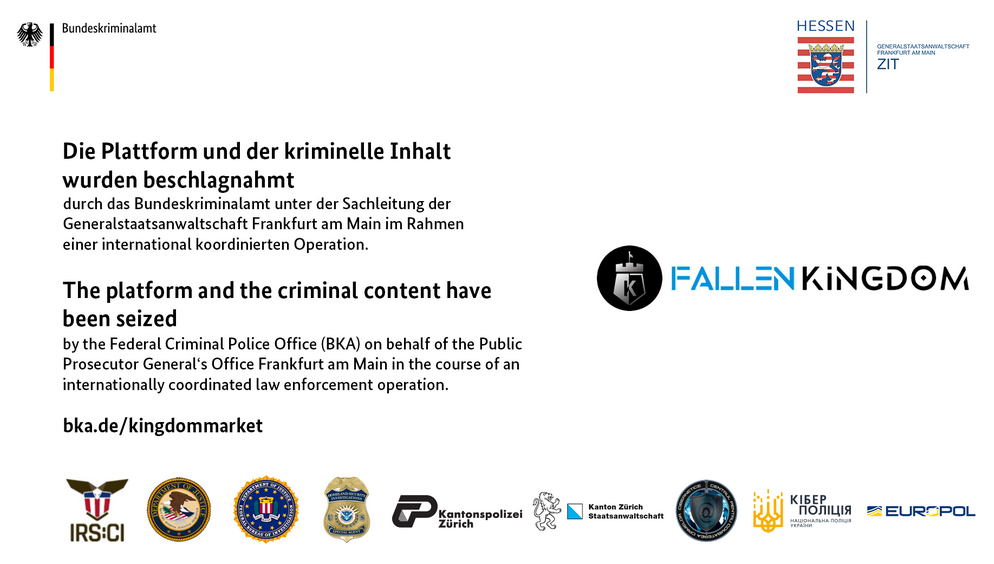
The end came slowly, then suddenly. On December 16, support staff on Dread admitted to "outages," followed by a flurry of reassurances from admins blaming sophisticated DDoS attacks and promising fixes within a day. By December 18, Dread admin /u/Paris posted a PGP-signed statement revealing the truth: individuals with server access had been arrested and their systems seized.
What Paris Said
The Dread announcement was blunt, with enough of the infrastructure compromised, "the chances of Kingdom market returning is from being down is basically zero." The subdread would be archived, and users were reminded that anyone who followed proper OPSEC while ordering had little to fear.
The Pattern
Kingdom's collapse fits a familiar script: months of instability, vague excuses, then a police banner. It marks yet another major market lost to international enforcement, and a reminder that market admins, not just buyers, are squarely in investigators' sights.
Lessons for Users
As always with seized markets, the fallout is uncertain: escrow balances may be frozen, vendor reputations die with the site, and phishing clones often appear within days pretending to be "the new Kingdom." Verify everything through trusted channels, and trust no resurrection announcement.
In the middle of December 2023, a major chapter in darknet history came to an abrupt close. Kingdom Market, then one of the largest illicit marketplaces still operating inside the Tor network, stopped answering its users. Within days, the explanation became public: German investigators had arrested the individuals responsible for running the platform's core servers, and the machines themselves had been taken into police custody. What visitors encountered when they typed the marketplace's onion address was no longer a storefront at all, but the seal of Germany's Federal Criminal Police, known as the BKA, announcing that the service had been seized. The takedown echoed through forums, boards, and private channels almost immediately, because Kingdom was not a minor operation. Its collapse ended years of accumulated trust, a sprawling vendor ecosystem, and the hopes of buyers and sellers who had survived a string of earlier marketplace failures only to lose this one too.
A Marketplace Built on Survival
To understand the scale of what was lost, it helps to recall how Kingdom came to exist. It was founded in 2022, emerging during the messy aftermath of several prominent market closures that had left the anonymous trading ecosystem without a clear dominant player. Several rival markets had collapsed within a short span, some through police action and others through internal fraud, exit scams, and internal disputes. Kingdom positioned itself as a quieter, more discreet alternative, emphasizing longer uptime, a cleaner interface, and management that claimed to care about its community's safety. Whether those claims were fully earned is debatable, but the marketing worked: within months, Kingdom had drawn thousands of vendors and a large base of regular customers.
The marketplace traded primarily in narcotics and other prohibited goods, though like most large darknet bazaars it hosted listings for everything from stolen data and fraud tools to counterfeit documents. Its technical stack relied on standard market infrastructure, including escrow accounts, multisignature wallets, vendor ratings, and an internal messaging system for resolving disputes between buyers and sellers. Behind all of that sat a relatively small team of administrators and developers who controlled the servers, the database, the withdrawal queues, and the release of site updates. That concentration of power, shared by most markets of its era, is also where its vulnerability lay.
The Weeks of Silence
The first public sign that something was wrong arrived in mid-December, and it did not look like a takedown at first. Support channels on the Dread forum, the principal English-language hub for darknet discussion, began reporting that the market was experiencing repeated outages. Pages would fail to load, the login panel would stall, and ordering would sometimes hang indefinitely. Admins and moderators posted reassurances, attributing the interruptions to sustained distributed denial of service attacks, a common enough excuse on darknet forums to have become almost cliché.
What made this episode different was its duration. Earlier markets had also blamed DDoS attacks during periods of instability, but those incidents had typically been resolved within days, or at least the market had eventually returned. Kingdom's problems dragged on for over a week. Users compared notes about whether the site had been reachable for them, questioned whether their funds were still safe inside the escrow system, and debated whether the platform was being pushed offline deliberately by its own operators. The ambiguity itself became part of the story, because nobody on the outside could tell whether the market was being attacked, abandoned, or quietly dismantled by the very people running it.
The Confession on Dread
The truth surfaced on December 18, 2023, when a Dread administrator posting under the handle /u/Paris published a statement signed with PGP. The cryptographic signature mattered: on a forum where impersonation is routine and trust is scarce, a verified message carried considerably more weight than an anonymous rumor. Paris confirmed that the marketplace's infrastructure had been compromised, that individuals holding access to the servers had been arrested, and that the affected systems had been seized by law enforcement. The announcement did not name the agency in the forum post itself, but the subsequent discovery of seizure banners made the responsible party clear.
The tone of the message was grim and unusually candid. Paris stated that with so much of the underlying infrastructure in police hands, the odds of Kingdom ever returning online were essentially nonexistent. The community's subdread, the dedicated discussion space for the marketplace, would be archived rather than deleted, preserving years of conversation as a historical record. The post also offered a brief reassurance to cautious users: those who had maintained strict operational security while shopping on the market had relatively little to fear from the exposure itself. That was small comfort for everyone else.
The BKA Banner
The most visible artifact of the operation was what replaced the marketplace itself. Users who navigated to Kingdom's onion addresses did not find a seized-domain placeholder or a generic error. Instead, the pages displayed a formal notice bearing the identity of Germany's Bundeskriminalamt, the federal criminal police office. The banner made plain that the domain and its content were under seizure as part of a criminal investigation, a standard technique used in darknet takedowns to strip control from operators and warn visitors that the platform was no longer legitimate.
Seizure banners serve several purposes beyond announcing an arrest. They destroy the market's brand, since a page bearing a police seal cannot convincingly pretend to be the same store users trusted yesterday. They also create a psychological shock for anyone still holding links, forum posts, or bookmarks, because encountering the banner confirms that the long-feared collapse was real and not another exaggerated rumor. In Kingdom's case, the banner effectively turned one of the dark web's busiest storefronts into a monument to a finished investigation.
Why Arresting Admins Ends a Market
Darknet markets are surprisingly fragile despite their technical sophistication. A marketplace can survive losing individual vendors, absorbing fraud scandals, and weathering public criticism, but it rarely survives the loss of the people who control the servers. Admins and developers hold the keys to everything that matters: the database containing user accounts and balances, the escrow wallets that hold buyers' cryptocurrency until orders are completed, the signing keys that authenticate site updates, and the operational knowledge needed to keep the platform running. When those people are taken into custody, the market does not merely pause; its foundation is removed.
There is also a practical reason investigators target administrators rather than individual buyers. A single arrest at the top of the organization can unravel an entire enterprise. Servers can be imaged and analyzed, encryption keys recovered, chat logs preserved, and payment flows traced. Every additional piece of evidence gathered during such an operation can feed further charges against the detained operators or provide leads toward accomplices. For the marketplace itself, the exposure of server access is fatal, because there is no quick way to rebuild trust once the infrastructure is known to be in police hands.
What Happened to the Money
For users, the arrest raised an urgent and largely unanswered question: what happened to the funds sitting inside Kingdom's escrow system? On a functioning market, cryptocurrency deposited into escrow is held by the platform until a buyer confirms receipt of an order. With the market suddenly offline and its administrators in custody, those balances entered a legal gray zone. There is no customer support channel to appeal to, no staff to process withdrawals, and no clear mechanism for recovering deposits that were never released to vendors.
History offers little comfort. When other major markets have been seized, users' escrow balances have typically been frozen or absorbed into the investigation, with recovery depending on the specifics of each case and the jurisdiction handling the seizure. Some users may eventually see funds returned through legal processes, but such outcomes are rare, slow, and far from guaranteed. The practical advice given to affected customers was the same as in every prior takedown: document transaction IDs and order histories, preserve any evidence of balances, and treat any claim that funds can be recovered through a quick payout as almost certainly fraudulent.
The Clones Are Coming
One predictable consequence of a major market's disappearance is the appearance of lookalike sites. Within days of Kingdom's seizure, darknet observers began warning about phishing clones attempting to capitalize on the name recognition and, in some cases, the desperation of displaced users. These fake markets typically advertise themselves as "Kingdom Market 2.0" or a successor project, sometimes claiming to have been launched by former admins or to hold migrated user databases. The claims are almost universally lies, and the sites exist to harvest credentials, cryptocurrency deposits, or both.
The pattern is well documented. After previous market closures, operators of fraudulent copycat sites have contacted former users through forums, reposted old links under new addresses, and even forged announcements purporting to come from trusted community figures. The safest response remains unchanged: treat every unsolicited resurrection announcement as hostile until proven otherwise, verify identities through established channels rather than private messages, and never deposit funds into a marketplace that cannot demonstrate a verifiable history and legitimate infrastructure. A sudden, convenient successor is usually a trap, not a lifeline.
Another Domino in the Enforcement Chain
Kingdom's fall fits into a long sequence of darknet marketplace takedowns stretching back more than a decade. Each operation follows a recognizable arc: months or years of operation, growing visibility and transaction volume, eventually attracting the sustained attention of international law enforcement, and finally a coordinated action that removes administrators, seizes infrastructure, and replaces the site with a police notice. Markets such as Silk Road, AlphaBay, Hansa, and Wall Street Market each met this fate, and Kingdom's seizure continued the trend into a new year of enforcement.
What is notable about the pattern is that the targets keep getting larger and the methods more sophisticated. Early takedowns often relied on a single undercover operation or a lucky technical break. Modern operations increasingly involve months of infiltration, international cooperation between agencies, and the patient tracking of cryptocurrency flows across borders. For administrators, the lesson is that anonymity provides less protection than it once did, because the people running a market leave traces in infrastructure, communications, and financial transactions that patient investigators can eventually follow. For users, the lesson is that even the most established markets can vanish overnight, and any balance held there is only as safe as the operation behind it.
The Community Aftermath
In the days following the seizure, the darknet community processed the news much as it had after previous takedowns: with a mixture of grief, dark humor, and pragmatic calculation. Vendors who had built reputations on Kingdom lost their storefronts and their sales history overnight, though many began advertising on surviving markets within days. Buyers scrambled to move their cryptocurrency to new platforms, weighing the risks of fragmented liquidity against the possibility of losing funds entirely. Forums filled with debates about which market might absorb the displaced population, and whether the era of dominant bazaars was giving way to smaller, more specialized operations.
The archived subdread preserved the community's final conversations, serving as a record of how users experienced the collapse in real time. Those threads capture the fear, the anger, and the resignation that accompanies the sudden death of a trusted platform. They also document the speed with which the ecosystem adapts, because the disappearance of one market rarely means the disappearance of demand. New venues will emerge, old ones will attempt comebacks, and the cycle of growth, fraud, and enforcement will continue. Kingdom's administrators may have been removed, but the market they built was merely one chapter in a much longer story.
Final Reflection
The seizure of Kingdom Market was not just the loss of a website. It was the collapse of a trust structure built over more than a year, the disappearance of escrowed funds that may never be recovered, and the end of careers and reputations for the people who ran it. The BKA banner now standing where the marketplace once operated is a reminder that even inside the Tor network, no platform is beyond the reach of determined law enforcement.
For everyone else watching from the forums, the lesson is older than the market itself: anonymity is not immunity, and the only guaranteed safe balance is the one you never leave unattended. Kingdom will be remembered less for what it sold than for how it ended, and its administrators' arrest sent a clear message to every remaining market operator that patience, not cleverness, is what investigators rely on.
Kingdom Market is gone, but the ecosystem it served will move on to the next platform, the next administrator, and the next investigation. Until that cycle breaks, the safest assumption for anyone navigating these spaces is that every market is temporary, every balance is at risk, and every promise of permanence deserves skepticism.

Comments 0