
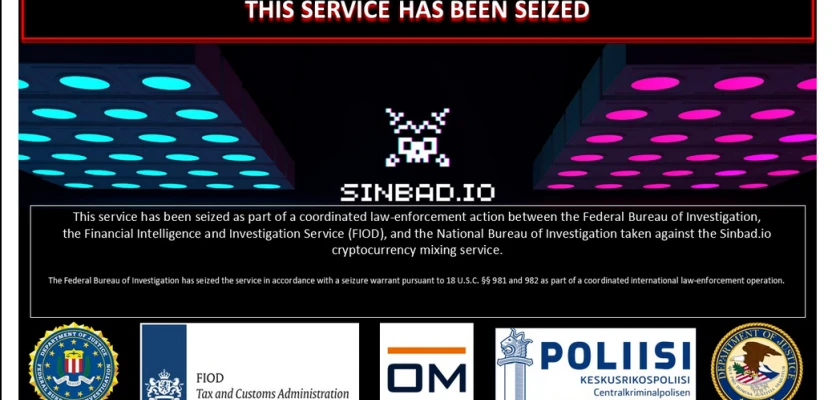
On the surface, Sinbad.io looked like yet another anonymity service running quietly in the background of the internet. In practice, it had grown into one of the largest cryptocurrency mixing platforms ever operated, processing staggering volumes of Bitcoin for users who ranged from ordinary privacy advocates to state-sponsored hacking crews. When American and European authorities moved against it in late 2023, the shutdown did not just kill a website. It sent a clear message that the era of treating coin tumblers as legal gray-area tools was drawing to a close.
The Service Behind the Name
Sinbad.io offered a straightforward promise: send Bitcoin in, receive different Bitcoin back, with no paper trail connecting the two sides. To deliver on that promise, the platform pooled deposits from thousands of participants and sent them onward through carefully choreographed transaction chains. Timing randomization, fee adjustments, and multiple intermediary hops were built into the workflow, so that each withdrawal emerged from the pool looking nothing like the deposit that funded it.
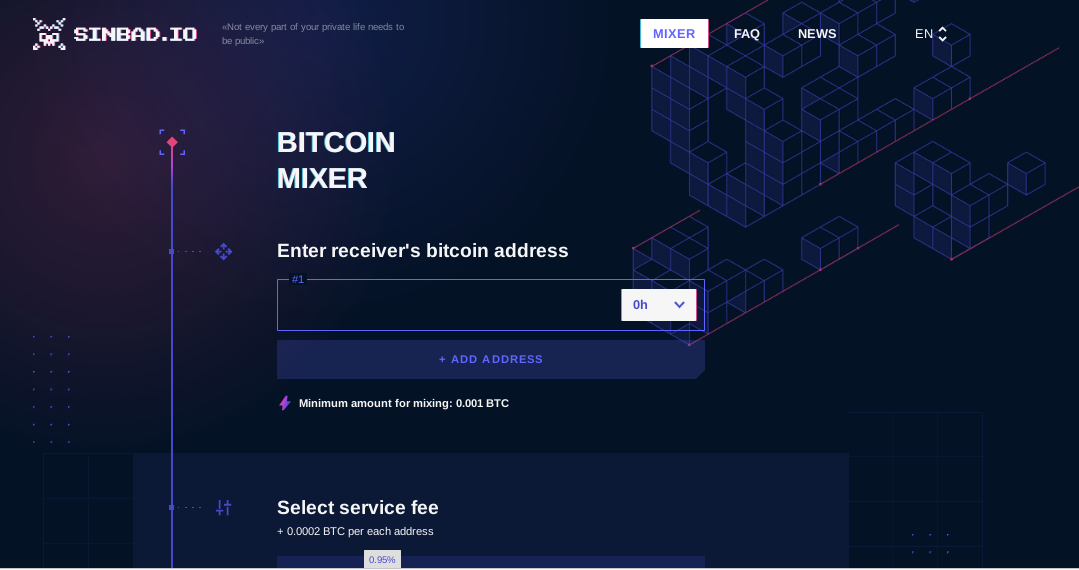
The interface deliberately mimicked a legitimate financial product. Users could generate a session address, paste a destination wallet, pick a payout delay, and watch their coins move through the system. Behind that clean user experience sat infrastructure engineered for scale. Sinbad handled volumes that dwarfed most other mixing services of its era, which is precisely what made it so valuable to the people who eventually attracted federal attention.
How Mixing Defeats the Blockchain
Understanding why authorities cared about Sinbad requires grasping a counterintuitive fact about cryptocurrency itself. Blockchains are designed to be permanent, public ledgers. Every transaction is recorded forever, and every address balance is visible to anyone with a browser. For all the talk of anonymity in crypto, ordinary Bitcoin is astonishingly easy to trace. Send coins from an exchange account to an address, then send them somewhere else, and a blockchain analyst can follow the trail in minutes.
Mixer services exploit that architecture rather than breaking it. By combining inputs from many users and outputting funds to many destinations, they create a combinatorial fog. A given withdrawal could plausibly have come from any of hundreds of deposits. The service essentially weaponizes the public nature of the ledger against itself, turning transparency into plausible deniability. That technical elegance is also what made Sinbad dangerous from a law enforcement perspective: it industrialized the process of severing the link between a crime and its proceeds.
A Customer List That Read Like a Dossier
The scale of Sinbad's clientele became public through sanctions designations and blockchain forensics. The most prominent name attached to the service was North Korea's Lazarus Group, a state-backed hacking organization whose operations had already cost the crypto ecosystem billions of dollars. Investigators linked proceeds from major thefts, including the 2022 Harmony Horizon bridge exploit and the 2022 Axie Infinity Ronin Network heist, to funds that flowed through Sinbad's mixing pools.
Hackers were not the only regulars. Ransomware crews, darknet market operators, and fraud networks all needed the same thing Sinbad sold: clean coins that no longer pointed back to a stolen wallet. Reporting on the takedown noted that the platform had processed roughly $100 million linked to the Lazarus-linked theft of user funds from Atomic Wallet, and that escrow-style payments between parties on hidden marketplaces also moved through its channels. The platform's operators had marketed Sinbad partly as a tool for ordinary users, but its business model quietly depended on customers whose transactions would have been difficult to explain anywhere else.
Sanctions Come First
The formal case against Sinbad began with paperwork rather than handcuffs. In late November 2023, the U.S. Treasury Department's Office of Foreign Assets Control designated the service under sanctions authorities, effectively making it illegal for anyone subject to U.S. jurisdiction to interact with it. OFAC designations carry real teeth: exchanges, payment processors, and infrastructure providers that kept doing business with the listed entity risked losing access to the American financial system.
Sanctions also function as a public naming exercise. By listing Sinbad officially, Treasury put every exchange and compliance department on notice that funds originating from the mixer needed scrutiny. The designation gave private companies a legal obligation and a clear signal at the same time. It transformed an anonymous crypto service into a known quantity that regulated businesses could no longer treat as just another address on a list of thousands.
The Raid and the Disappearance
Days after the sanctions landed, a coordinated international operation shut the service down. The FBI led the effort with Dutch and Finnish authorities contributing, and the result was swift and total: Sinbad's websites and its Tor onion mirror went dark, its infrastructure was seized, and the operator, who went by the handle Mehdi, lost the platform he had built over years. Users who had trusted the service with deposits discovered that the front door no longer answered.
What made the takedown notable was not just its speed but its completeness. Seizing a distributed service that processed funds across borders is genuinely difficult; operators typically scatter servers, rely on anonymous hosting, and keep minimal records. That Sinbad fell so cleanly suggested either unusually poor operational security or an investigation that had been building quietly for months. Investigators had clearly been watching the money long before they took the doors off.
Why Mixers Became the Target
Sinbad's collapse fits a broader shift in how governments view cryptocurrency mixing. For years, mixers occupied an ambiguous space: privacy advocates argued they protected dissidents and ordinary users from surveillance, while critics warned they laundered ransomware payouts and darknet commerce. The tipping point came when high-volume mixers became the default cash-out layer for some of the largest crypto thefts on record. Once Lazarus Group was repeatedly traced through mixing services, the debate shifted from whether mixers were legitimate to which ones law enforcement would tolerate.
The enforcement trend that followed has been consistent. Authorities have pursued mixers through sanctions, domain seizures, and criminal charges, while pressuring exchanges and wallet providers to flag transactions involving them. Each high-profile takedown raises the cost of running a laundering service and pushes remaining operators toward smaller, more fragmented alternatives. The goal is not merely to remove one website but to make the entire category of high-throughput mixers harder to operate.
The Privacy Argument Under Pressure
Critics of the crackdown point out that mixer technology itself is neutral. Legitimate users have real reasons to want financial privacy: journalists protecting sources, activists operating in hostile jurisdictions, and ordinary people who simply dislike having every purchase readable by strangers. The same tools that obscure a ransomware payment also obscure a dissident's savings. When regulators treat all mixing as suspect, they risk pushing privacy-seeking users toward less transparent or outright criminal alternatives.
Prosecutors have generally countered that volume and context matter. A service processing billions in transactions with documented ties to state hackers and ransomware groups is not equivalent to a privacy tool used occasionally by concerned citizens. The legal theory behind the Sinbad action, and similar cases, is that a business model built substantially on laundering criminal proceeds is itself criminal, regardless of what some users might use it for. That distinction will continue to be tested in courts as challenges to mixer enforcement move forward.
The Aftermath for the Crypto Underworld
The immediate effect of Sinbad's seizure was disruption. Funds that might have flowed through the service needed new paths, and operators scrambled to find replacements or build their own mixing capabilities in-house. Yet history suggests disruption is temporary. Criminal enterprises adapt quickly, rotating between services, adopting chain-hopping techniques that move funds across multiple blockchains, and experimenting with privacy-focused coins designed to resist analysis.
The longer-term consequence is harder to measure but arguably more important. Each enforcement action strips a layer of confidence from the criminal supply chain. Mixers that survive must absorb higher compliance risk, more investigative scrutiny, and the possibility that their operator will end up on a sanctions list. For some, that risk becomes prohibitive; for others, it simply gets priced into the cost of doing business. The cat-and-mouse dynamic continues, but the stakes have risen for everyone in the chain.
Lessons From the Takedown
Sinbad's story illustrates several durable truths about crypto crime enforcement. First, patience pays: blockchain analytics can reconstruct transaction histories years after the fact, meaning criminals cannot assume old movements are safe. Second, coordination matters. The takedown succeeded because multiple jurisdictions acted in concert rather than leaving the service to operate in the gaps between legal systems. Third, the financial system's choke points remain powerful. Even pseudonymous actors eventually need exchanges, payment rails, or infrastructure they cannot fully control.
There is also a quieter lesson about scale. Sinbad was not a small operation; it was infrastructure, processing volume comparable to legitimate financial services. When such services become dominated by criminal flow, the legitimate framing collapses. The remaining question is whether the enforcement model pioneered here, built on sanctions designations and international seizures, can keep pace with an ecosystem where new mixing services can launch faster than old ones can be shut down.
What the Future Holds
The crypto laundering landscape will not simply empty out after Sinbad. New services will appear, existing ones will fragment into smaller pools, and techniques like cross-chain swaps and privacy coins will fill gaps left by seized mixers. Sophisticated actors have already demonstrated they can route funds through multiple hops across different protocols. Expect enforcement to respond with the same tools it used here: forensic tracing, sanctions pressure, and coordinated takedowns aimed at whoever operates the next high-volume service.
The lasting significance of Sinbad's seizure lies less in one website's death than in the precedent it set. A service that once processed billions in transactions now sits on a sanctions list, its operator persona burned, and its infrastructure seized. For every operator watching, that is a concrete demonstration that anonymity infrastructure is not beyond reach. For privacy advocates, it is a warning that the boundary between legitimate confidentiality and criminal laundering is being redrawn, and where that line falls will shape the future of both cryptocurrency and the investigators trying to police it.

Comments 0