
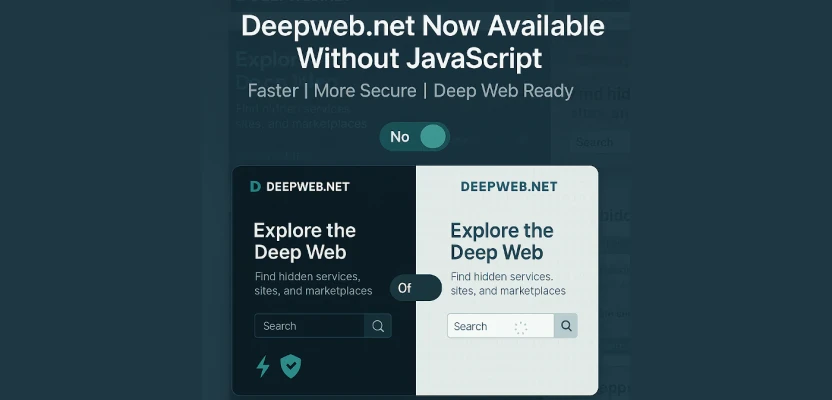
OnionInfoDesk now delivers its entire site without executing a single line of JavaScript in your browser. Every article, catalog page, and tool description renders as plain HTML and CSS, which means faster load times over Tor, a dramatically smaller attack surface, and far fewer opportunities for fingerprinting — all while keeping the content identical to what scripted visitors see.
Why We Built a JavaScript-Free Experience
The modern web assumes JavaScript is mandatory, but that assumption carries real costs for anonymity-conscious readers. Scripts run with broad access to your browser environment: they can query timers, measure rendering behavior, enumerate capabilities, and open network connections you never asked for. On the clearnet this is mostly a privacy nuisance. On the dark web, it can be a genuine security problem.
We decided that reading about onion services, marketplaces, and privacy tools should never require executing code you cannot audit. Our goal was simple: a visitor running Tor Browser at the Safest security level should get a first-class experience, not a degraded fallback. The no-JavaScript build is now the primary way we develop and test the site, not an afterthought bolted on for compatibility.
This approach also reflects how we think about trust. You should not have to trust our code, our analytics provider, or our content delivery pipeline to read an article. If no script executes, there is nothing to compromise on the client side — the page you receive is the page that renders.
What JavaScript Can Actually Do to a Tor User
JavaScript is the largest source of browser-based deanonymization risk. Historically, the most serious attacks against Tor users — including the FBI's deployment of the Freedom Hosting exploit in 2013 and the Firefox zero-day that followed in 2016 — relied on script execution to trigger memory corruption and bypass the browser sandbox. Disabling JavaScript removes the delivery mechanism for entire classes of these attacks.
Beyond exploits, scripts enable fine-grained fingerprinting. Canvas rendering, font enumeration, timing measurements, and API surface probing can combine into a stable identifier that follows you across sessions. Tor Browser mitigates much of this, but mitigations are strongest when the code attempting the fingerprinting never runs at all.
There is also the quieter problem of behavioral leakage. Scripts can observe scroll depth, mouse movement, tab focus, and how long you linger on a paragraph. For readers researching sensitive topics, that telemetry is information they never intended to share. A static page leaks none of it, because there is nothing on the page capable of observing you.
It is worth stressing that none of these risks are hypothetical. Browser exploits are bought and sold precisely because script engines are enormous, complex attack surfaces written in memory-unsafe languages. Every year brings new vulnerabilities in JavaScript engines, JIT compilers, and WebAssembly runtimes. A page that never invokes that machinery inherits none of that exposure — the exploit catalog simply does not apply to a document with no interpreter awake.
How the No-JavaScript Version Works
Our pages are authored as semantic HTML first. Navigation, dropdowns, and expandable sections use pure CSS techniques — checkbox toggles, the :hover and :focus pseudo-classes, and native <details> elements — so interactive affordances still work without a scripting engine. Where a feature genuinely requires computation, such as our server-side tools, the work happens on the backend and the result arrives as a normal page load.
If you visit with scripts enabled, the site behaves the same way. We did not fork the codebase into a "rich" version and a "lite" version; there is one document, progressively enhanced where it helps and fully functional where it does not. This keeps maintenance honest — anything broken without JavaScript is simply broken, and we fix it.
The discipline required to build this way is genuinely clarifying. When you cannot reach for a script to hide a structural problem, every page has to earn its layout through markup alone. Our templates became simpler, our CSS more deliberate, and our testing more meaningful, because "does it work without JavaScript?" is now the first question asked of every change rather than the last.
Speed Benefits Over the Tor Network
Tor circuits add latency to every request. A typical clearnet page might fire off thirty or forty script, font, and tracking requests before it becomes usable; each one multiplies the delay across three relays. Our no-JavaScript pages make a handful of requests at most — the HTML document, a stylesheet, and occasionally an image — so pages become readable in a fraction of the time.
Smaller payloads also matter on constrained connections. Readers on mobile data, throttled networks, or low-bandwidth bridges benefit from documents measured in tens of kilobytes rather than megabytes. There is no hydration step, no framework bundle to parse, and no render-blocking script tag standing between you and the text.
Performance is a security property too, in a less obvious way. Slow sites push impatient users toward risky workarounds — disabling security settings, trying unofficial mirrors, or abandoning Tor for a direct connection. When a privacy resource loads instantly even over a congested circuit, there is no temptation to trade safety for convenience. We treat every millisecond of render time as part of the trust relationship with our readers.
What Still Works Without Scripts
Everything essential. The full article archive, category browsing, search results rendered server-side, the onion service catalog, and all long-form guides load and read exactly as intended. Images use lazy loading through native HTML attributes rather than JavaScript observers, and tables of contents are ordinary anchor links that work in every browser ever shipped.
Forms on the site — contact, submission, and feedback flows — submit through standard HTTP POST requests with server-side validation, the way the web worked for its first two decades. We found during the rebuild that very little of what JavaScript is typically used for was actually serving the reader; most of it was serving the platform.
What We Deliberately Left Out
You will not find autoplaying media, infinite scroll, pop-over banners, or engagement widgets here. Some of that is a technical consequence of going script-free, but most of it is a philosophical choice. Dark web content should not feel like a casino. When you finish an article, the page is done — it does not chase you for attention.
A few conveniences do disappear. There are no live search suggestions, no instant theme toggles without a reload, and no embedded interactive charts. We judged each omission and kept the ones where a static alternative — a results page, a settings link, a downloadable dataset — serves the same need honestly.
If an interactive feature ever returns, it will arrive as an optional enhancement layered on top of a page that already works, never as a dependency. Readers who allow scripts might get a small convenience; readers who do not lose nothing of substance. That asymmetry is deliberate and permanent.
How to Get the Maximum Benefit
The simplest step is to set Tor Browser's security level to Safest, which disables JavaScript globally. You will notice immediately that our site renders completely while many others break — that contrast is the point of this launch. If you prefer the Safer level, JavaScript is already blocked on non-HTTPS pages, but Safest removes the ambiguity entirely.
Advanced users can go further with tools like NoScript, which ships with Tor Browser, to whitelist scripts selectively on sites that genuinely need them. Our recommendation is to treat script execution as a per-site decision rather than a default: allow it where you have a reason, deny it everywhere else. On this site, you will never need to allow it.
Why This Matters for the Dark Web Ecosystem
Onion services have always had a strained relationship with JavaScript. Many serious operators disable it outright, and experienced users have learned to distrust any hidden service that demands scripts to display text. Yet the tooling of the modern web keeps pushing sites in the opposite direction, toward heavier clients and more client-side execution.
We think the ecosystem is healthier when information resources prove they do not need to run code on your machine. A no-JavaScript site is easier to mirror, easier to archive, easier to serve from minimal infrastructure, and far harder to booby-trap. If more dark web resources adopted this posture, the baseline risk of simply reading on Tor would drop substantially.
Frequently Asked Questions
Do I need to change any settings to use the no-JavaScript version?
No. If your browser has JavaScript disabled — for example, with Tor Browser set to Safest — the site works automatically. There is no separate URL, toggle, or opt-in required.
Is any content missing compared to the JavaScript version?
No article, listing, or guide is withheld. Minor conveniences like instant search suggestions are replaced with standard server-rendered pages, but the substance of the site is identical.
Does disabling JavaScript make me completely anonymous?
It removes one major attack surface, but anonymity depends on your whole setup: using Tor Browser correctly, avoiding plugins, not resizing the window to unusual dimensions, and never entering identifying information. Think of script-free browsing as a strong foundation, not a complete solution.
Will you ever require JavaScript for any feature?
Our commitment is that core reading and navigation will always work script-free. If a future tool genuinely needs client-side computation, it will be isolated, clearly labeled, and optional — never a prerequisite for accessing information.
The launch of our fully no-JavaScript experience is a permanent commitment, not an experiment: OnionInfoDesk will continue to publish everything in a form that asks nothing of your browser except the ability to render text. Whether you are running Tor Browser at Safest, browsing through a minimal client, or simply tired of the bloated modern web, the site is ready for you — faster, leaner, and safer by design.

Comments 0