
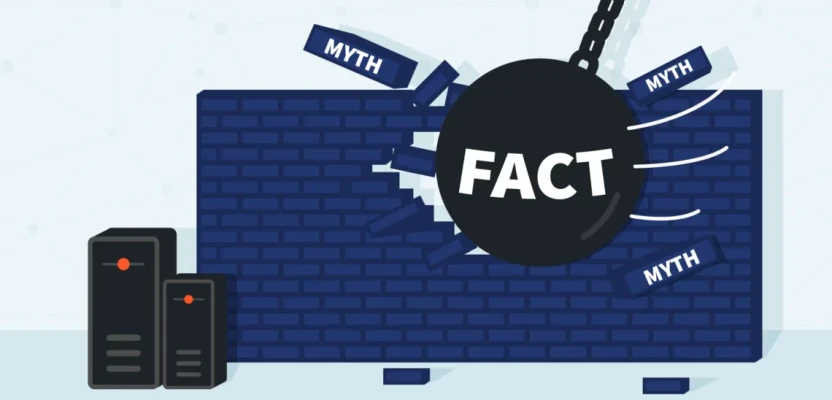
The dark web has a reputation problem. Movies, news headlines, and political speeches have together built an image of a shadowy realm where every click leads to a crime. In reality, the dark web is a relatively small slice of the internet used by a wide variety of people for a wide variety of reasons, most of which have nothing to do with buying drugs or hiring assassins. Separating what is true from what is merely rumored requires looking past the sensational claims to how the technology actually works and who genuinely relies on it.
What the Dark Web Really Is
Most people picture a single hidden website that criminals log into. In truth, the dark web refers to a collection of encrypted services reachable only through specialized software such as the Tor browser. Websites on it use .onion addresses instead of familiar .com or .org domains, and they sit outside the indexing systems that make the regular web searchable. Think of the internet as a house with many rooms: the surface web is the furnished living room that search engines have catalogued, the deep web is the bedroom containing paperwork only you can open, and the dark web is the basement accessible through a specific door with a specific key. None of these are criminal; they are simply private.
Worth noting is that much of what people casually call "the internet" is already not searchable. Your email inbox, online banking records, medical portals, and private company documents all live on the deep web, meaning no search engine can find them. The dark web differs only in the method of access, not in purpose.
It also helps to dispel the idea that the dark web is one thing. Hidden services range from personal blogs to major news organizations, and their quality varies as wildly as it does on the visible web. Some are professionally run; many are abandoned experiments or outright scams. Treating the whole space as a monolith is the first mistake visitors make.
Using It Is Not the Same as Committing a Crime
A persistent myth insists that simply installing Tor or visiting an .onion site is illegal. It is not, in most countries. Tor is open-source software maintained by a nonprofit and has even received funding from the United States government, precisely because privacy tools benefit journalists, researchers, and ordinary citizens. Reading an anonymous forum or a library of censored books violates no law. What crosses the line is the activity itself: purchasing controlled substances, distributing harmful material, or offering fraud services. The tool is neutral, much like a lockpick is neutral until someone uses it on a door that is not theirs.
The confusion comes from conflating anonymity with wrongdoing. People choose anonymity for dozens of legitimate reasons: a writer in an authoritarian state avoiding surveillance, an abuse victim contacting a helpline without revealing their location, or a researcher studying sites they cannot reach any other way.
How Much Illegal Activity Is Really There
You may have heard the claim that roughly 96 percent of dark web content is illegal. That figure traces back to a 2014 study that sampled a small number of .onion sites and made assumptions that researchers themselves later criticized. More careful analyses, including studies of Tor network traffic, suggest the reality is far less dramatic. A large portion of hidden services are ordinary forums, archives, blogs, software repositories, and privacy-conscious commercial sites. Illegal marketplaces and criminal forums certainly exist, and they receive heavy coverage from researchers and journalists, which makes them feel more common than they actually are.
This is not to say the criminal segment is trivial in absolute terms. Even a modest share of the hidden web still represents thousands of sites. But proportionality matters: the dark web is not a single economy of crime, and treating it as one distorts every other fact about it.
Who Actually Uses the Dark Web
Beyond criminals, the dark web hosts a surprisingly ordinary ecosystem. News outlets run .onion mirrors so readers in censored countries can bypass firewalls. SecureDrop, the platform used by major newspapers for anonymous tips, operates exclusively over Tor. Libraries archive censored material, academics host research, and activists coordinate under repressive regimes. There are even everyday-looking stores and discussion boards where the only unusual feature is the address bar.
The typical Tor user may be someone whose threat model is real: a domestic abuse survivor, an LGBTQ individual in a hostile country, or a whistleblower who cannot afford to be identified. For them, the dark web is not exotic at all. It is a lifeline.
Organizations that serve vulnerable populations have been especially quick to adopt it. Domestic violence shelters, LGBTQ support groups, and addiction recovery communities in repressive regions all maintain .onion presences precisely because anonymity can function as a safety feature rather than a concealment tool.
Anonymity Is Strong, but It Is Not Magic
Tor routes traffic through multiple volunteer-run relays, encrypting it in layers so that no single relay sees both who you are and where you are going. That design has held up remarkably well against state-level adversaries. However, anonymity tends to fail at the edges rather than in the middle. Users who log into personal accounts, reuse usernames across the clearnet and .onion sites, download files that secretly phone home, or get careless with operational security have deanonymized themselves repeatedly. The technology protects the network layer; it cannot protect against mistakes made by the person holding the keyboard.
There is also a difference between being anonymous and being untraceable forever. Timing analysis and traffic correlation remain active areas of research, and agencies have at times run their own relays or exploited browser vulnerabilities. The honest summary is that Tor raises the cost of identification enormously without promising anyone complete immunity.
The Economics of Dark Web Markets
When people discuss dark web markets, they picture a functioning Amazon for crime. The reality is more fragile. Markets rise and fall constantly: Silk Road was seized in 2013, AlphaBay collapsed in 2017, and successor markets inherit the users but rarely the stability. Escrow services, reputation systems, and vendor ratings exist to manage trust in an environment where nobody can sue anyone, yet fraud remains rampant and long-term reliability is rare.
Payments run almost entirely on cryptocurrencies, usually Bitcoin and increasingly Monero for its privacy properties. Even so, blockchain transactions are traceable in ways casual users underestimate, and several major takedowns came from following the money rather than breaking any encryption.
Why Law Enforcement Keeps Winning
The popular belief that the dark web is beyond police reach is simply outdated. Agencies do not need to defeat Tor's mathematics when they can exploit the human layer instead. Undercover agents infiltrate forums, administrators get careless and reuse credentials, server misconfigurations expose real IP addresses, and buyers' operational mistakes provide leads. The takedown of major markets typically followed months of infiltration rather than any cryptographic breakthrough.
International cooperation has also improved substantially. Europol, the FBI, and national agencies now share intelligence across jurisdictions, and cryptocurrency tracing firms have become routine partners in financial investigations.
Famous Cases That Fed the Legend
Several real events did much to cement the dark web's sinister image. Ross Ulbricht, the alleged founder of Silk Road, became a household name after his 2013 arrest and subsequent life sentence, and his case is still cited in debates about sentencing and government overreach. The AlphaBay takedown in 2017 involved an administrator arrested while on honeymoon abroad, a detail that seemed lifted from fiction. These stories are true and deserve attention, but they describe a minority of what actually happens there.
What gets far less coverage is the quieter traffic: researchers downloading censored texts, families checking on relatives overseas, and ordinary people who simply prefer not to be tracked by advertisers. The loud cases travel much farther than the quiet ones, which is exactly how a niche privacy tool acquired a reputation as a criminal headquarters.
What Happens If You Visit Anyway
Curiosity is understandable, and the Tor Browser itself is safe to download. The risks concentrate in behavior: clicking random links, downloading unknown files, sharing personal information, or stumbling into illegal content that can carry legal consequences depending on your jurisdiction. Scams abound, many .onion sites are malware delivery fronts, and exit nodes mean your traffic is visible to the final relay unless you use HTTPS, which most sites support but users forget to verify.
If you do explore, sensible habits mirror general security practice: keep the browser updated, avoid logging into real identities, never send money to strangers, and treat every link as untrusted. The dark web is not uniquely dangerous so much as it is uniquely unforgiving of mistakes, because there is no customer support and no way to undo a bad click.
There is also a subtler risk: habit. Casual exploration can normalize a space where verification is nearly impossible, and users who once treated every link skeptically may grow careless over time. The safest mindset is to assume every site, every file, and every stranger is untrustworthy until proven otherwise.
The Dark Web in Context
Strip away the mythology and the dark web looks less like a criminal underworld and more like what it technically is: a privacy layer used by everyone from activists to opportunists. The same features that protect dissidents also protect predators; that is the honest trade-off of anonymity tools. The technology will not become less capable, and neither will the criminals who misuse it. What can change is public understanding. The dark web is not a secret society or a lawless paradise. It is a niche part of the internet, mostly ordinary, occasionally criminal, and almost never what the headlines claim.

Comments 0