
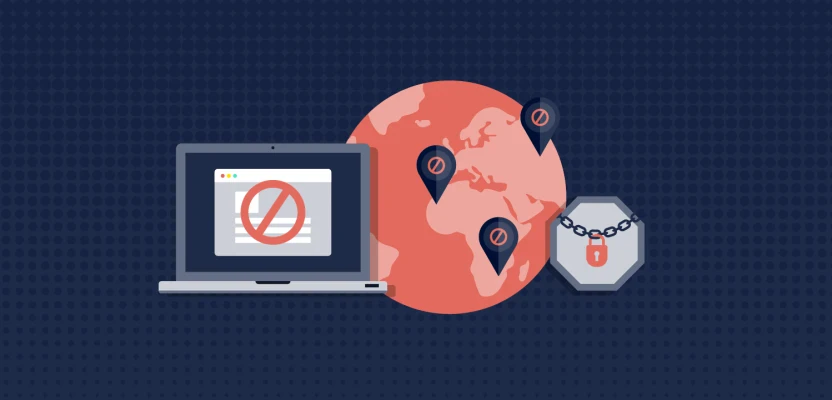
Internet censorship is the deliberate restriction of online access, speech, and information, and it is enforced through a combination of technical filtering, legal pressure, and infrastructure control rather than a single mechanism. Its consequences extend well beyond blocked websites: censorship reshapes how entire populations communicate, learn, dissent, and imagine what is possible online.
What Internet Censorship Actually Means
At its core, censorship is the attempt to make certain information unavailable, inconvenient, or risky to find. Unlike traditional censorship, which required physically confiscating books or newspapers, digital censorship operates at the network layer, where a small number of choke points can intercept traffic for millions of users at once. A government that controls the gateways between its citizens and the rest of the internet can decide, in real time, which sites resolve, which connections complete, and which content reaches a screen.
The targets follow a fairly predictable pattern. Political content that criticizes leaders or promotes dissent draws the heaviest scrutiny, followed by independent news outlets, social media platforms that enable organizing, and anything classified as pornographic, violent, or "harmful." But the scope varies enormously: some states block a handful of domains, while others maintain national intranets that keep most citizens cut off from the global web entirely.
What unites these efforts is the underlying logic that information flows should be managed, not free. Whether the justification is protecting morality, national security, or public order, the practical effect is the same: an information environment curated by whoever holds the power to filter it.
Why Governments Censor in the First Place
Official explanations usually cite public safety, national security, or moral protection. In practice, researchers and rights groups consistently find that the primary motive is political: controlling narratives around elections, protests, ethnic tensions, and criticism of those in power. Censorship is cheap compared to propaganda and far more effective at suppressing organized opposition than arresting individuals one by one.
There is also an economic dimension. Some censorship protects domestic industries or state-owned enterprises from foreign competitors, while other regimes treat the open internet as a channel for foreign influence they wish to exclude. In a few cases, censorship is framed as data sovereignty, the claim that a nation should control the digital infrastructure and data flowing through its territory.
Whatever the stated reason, the burden of filtering falls unevenly. Journalists, activists, and ordinary citizens seeking accurate news pay the highest price, while officially sanctioned sources of information remain readily available.
How Censors Intercept Traffic: The Technical Toolkit
Modern censorship is not about deleting files from servers abroad, which is usually impossible. Instead, censors interfere with the process of reaching those servers. The techniques range from crude to highly sophisticated, and most large-scale systems combine several at once.
DNS manipulation is the simplest widely used method. When a user types a domain name, the system looks up its IP address through the Domain Name System; censors can poison those lookups or redirect them to fake addresses, so the intended site never loads even though it exists. IP blocking takes a blunter approach, refusing to route traffic to blacklisted server addresses entirely. Keyword filtering scans traffic for banned words, phrases, or patterns in real time. Traffic throttling slows connections to specific services so that video, messaging, or news sites become effectively unusable without being formally blocked. Each method has weaknesses, and determined users learn to work around them, which is why serious censorship systems rarely rely on just one.
Deep Packet Inspection and the Rise of Smart Filtering
The most capable censorship apparatuses go far beyond blocking addresses. Deep packet inspection, or DPI, allows filtering equipment positioned at network chokepoints to examine the contents of data packets as they pass through, not just where they are going. This enables censors to identify encrypted or unencrypted traffic, detect specific applications, and even infer what a user is doing online from traffic patterns alone.
DPI powers many of the subtler forms of control. A censor can block only the video streams of a platform while leaving its messaging features intact, throttle connections during protests, or flag users who repeatedly attempt to reach forbidden destinations. Machine learning has extended these capabilities further, letting systems adapt to new circumvention tools automatically and flag encrypted traffic that merely resembles the fingerprint of a prohibited service.
This escalation has turned censorship into an arms race. Every new evasion technique, from obfuscated proxies to randomized traffic padding, prompts countermeasures, and vice versa. The censors hold the structural advantage of controlling the pipes, but determined users and privacy tools keep the contest alive.
Throttling, Shutdowns, and Coercion Behind the Scenes
Not all censorship happens at the protocol level. Some of the most effective methods are deliberately blunt. Traffic throttling makes services unusable without producing a block page that might attract attention, and it can be applied selectively, for example degrading only video during political events. Internet shutdowns, the deliberate cutting of connectivity for an entire region or country, have become a routine protest-control tool in dozens of nations; they cost economies billions of dollars and silence entire populations at once.
Legal coercion extends censorship far beyond what any filter can achieve. Governments compel local internet service providers, domain registrars, app stores, and cloud hosts to remove content, hand over user data, or block services under threat of license revocation. Platforms that refuse risk losing access to lucrative markets, so self-censorship becomes widespread even where formal blocking is absent.
These softer pressures matter because they reach inside the services themselves. A blocked website can be reached through a tunnel, but a platform that voluntarily deletes content or cooperates with takedown requests is harder to circumvent, since the information is removed at the source.
The Countries Leading the Way
No single country exemplifies censorship; the landscape is a spectrum of approaches. China's Great Firewall is the most comprehensive and long-running system, blocking major foreign platforms such as Google, Facebook, YouTube, and Wikipedia while monitoring domestic traffic through real-name registration, surveillance, and an extensive apparatus of DPI and keyword filtering. Iran operates a national intranet alongside heavy filtering of foreign news and social media. Russia has progressively tightened controls, blocking independent media, restricting foreign platforms, and building the legal framework for a sovereign internet that can be severed from global routing. North Korea confines most citizens to Kwangmyong, a government-run intranet, with internet access reserved for a small elite.
Other states favor different mixtures of the same ingredients. Turkey routinely forces platforms to remove content and has repeatedly throttled or blocked social media during political crises. Egypt, Ethiopia, Myanmar, and India have used shutdowns and targeted blocking around elections and protests. Even in liberal democracies, debates over content moderation, lawful access demands, and platform accountability show that the tools of control travel well beyond authoritarian borders.
How People Circumvent the Filters
Wherever censorship exists, workarounds emerge. Virtual private networks encrypt traffic and route it through servers abroad, hiding both destination and content from local filters. Proxy servers offer a lighter version of the same trick, though without the same level of encryption. Tor sends traffic through multiple volunteer-run relays, making it extremely difficult to trace who is communicating with whom, and its pluggable transports disguise Tor traffic so it does not resemble anything a censor recognizes.
Smaller tools fill important niches. Private or encrypted DNS resolvers bypass DNS poisoning entirely. Mirror sites and decentralized services reproduce blocked content at addresses that are harder to block wholesale. Psiphon, Lantern, and similar circumvention tools are designed specifically to evade detection in hostile networks, sometimes using techniques like domain fronting or traffic obfuscation to look like ordinary HTTPS.
The effectiveness of these tools varies with the sophistication of the censor. Against crude DNS blocking, almost anything works; against a system with DPI, active probing, and machine-learning classification, circumvention requires constant innovation. Still, the asymmetry favors the determined individual: bypassing a filter is easier than filtering everything perfectly.
The Broader Consequences of a Filtered Internet
Censorship's costs are not confined to the blocked pages themselves. It produces a chilling effect, where people self-censor because they cannot tell what is monitored, and it fragments the internet into national or ideological bubbles where citizens of different countries encounter entirely different versions of reality. Economists document real damage: shutdowns disrupt commerce, blockades of platforms isolate businesses, and engineers in censored countries lose access to the documentation, tools, and communities that drive innovation.
There is also a security dimension. Filtered populations cannot access security updates, privacy tools, or uncensored reporting about threats to themselves. And the same infrastructure built for censorship, deep inspection boxes and centralized control points, can be repurposed for surveillance, turning the tools of information control into instruments of political power.
Defenders of censorship argue that it protects citizens from harmful content and foreign manipulation. Critics counter that the cure is worse than the disease: a population that cannot access uncensored information cannot meaningfully consent to the rules imposed on it. The internet was designed to route around obstacles; censorship is the effort to rebuild walls inside it.
Frequently Asked Questions
What is the difference between censorship and content moderation? Content moderation is the voluntary removal or labeling of material by a private platform according to its own rules, while censorship is coercive restriction imposed by a state or other authority, often backed by law. The distinction matters because moderation can be debated and appealed, whereas censorship is typically non-negotiable.
Can a VPN completely bypass internet censorship? A VPN defeats many common techniques, including DNS blocking and simple IP bans, because it encrypts traffic and routes it through a foreign server. However, sophisticated systems using deep packet inspection can detect and block known VPN protocols, throttle encrypted traffic, or force providers to comply with local laws, so no circumvention tool works everywhere.
Which countries have the strictest internet censorship? North Korea confines most citizens to a sealed national intranet and heavily restricts even that. China operates the world's most sophisticated large-scale filtering system, while Iran, Turkmenistan, and Eritrea combine total or near-total blocks of foreign services with surveillance and legal coercion. Russia, Vietnam, and Saudi Arabia maintain extensive but more selectively targeted systems.
Is internet censorship legal under international law? International human rights instruments, including the International Covenant on Civil and Political Rights, protect freedom of expression and access to information, and UN resolutions have affirmed that the same rights apply online. Many governments argue national security and public order justify restrictions, but human rights bodies increasingly hold that blanket blocking of entire platforms or services violates international norms.
Understanding how censorship works, from poisoned DNS lookups to deep packet inspection to blunt nationwide shutdowns, reveals it as less a wall than a system: layered, adaptive, and always evolving. The tools people use to reach around it, from VPNs to Tor to private DNS, are equally ingenious, and the contest between filtering and circumvention will define the shape of the internet for years to come.

Comments 0