
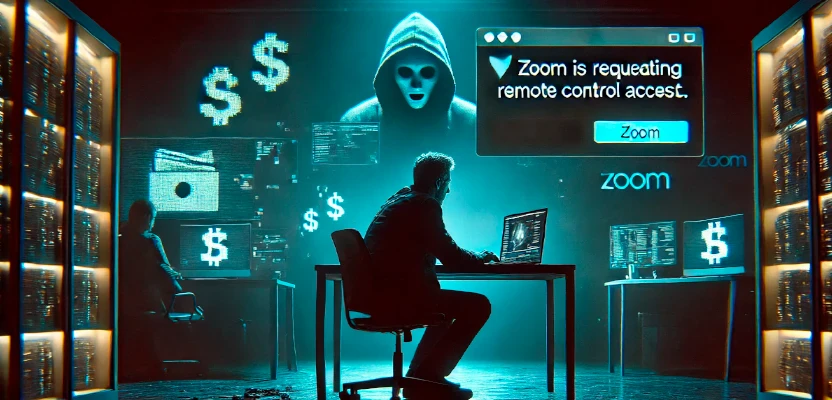
In late 2023 and early 2024, a string of thefts revealed that one of the safest places to talk to colleagues had quietly become a hunting ground. Crypto builders, founders, and investors were losing hundreds of thousands of dollars during ordinary-looking Zoom conversations — not through an exploit in Zoom's code, but through a carefully orchestrated lie about who was asking for control of their computers. The group behind the wave of losses, tracked by researchers under the name ELUSIVE COMET, built an entire fake venture capital operation around a single goal: getting a victim to press an "Allow" button during a podcast-style video call.
The Human Factor Is the Real Exploit
Most discussions of crypto theft focus on wallet vulnerabilities, smart contract bugs, and exchange hacks. This campaign skipped all of that. The attackers understood that the weakest link in any security chain is the person holding the keyboard, and they designed their entire operation around that insight. There was no zero-day, no leaked API key, and no phishing link waiting for a click in an inbox. Instead, everything happened live, face to face on a video screen, where social pressure did what malware usually does.
The technique centers on Zoom's remote control feature, which is enabled by default on most accounts. When a participant requests remote access, the host sees a prompt asking them to approve. It sounds harmless, even useful — sharing screens and helping each other with technical problems is exactly what video conferencing was built for. But once control is granted, an attacker can quietly install infostealer software, copy wallet files, grab browser-stored passwords, or sit silently while the victim continues working, taking screenshots and harvesting credentials in the background.
What made this campaign remarkable was the length of its runway. Victims weren't ambushed; they were recruited. The attackers invested weeks in building credibility before ever asking for anything. By the time the remote control request appeared, the victim had already met the attacker in person — sort of — and trusted enough to share their screen.
Anatomy of a Convincing Cover Story
The front for the operation was a fabricated venture capital firm called Aureon Capital. On paper, it looked legitimate: a polished website, active social media presence, professional branding, and a podcast titled The OnChain Podcast aimed at crypto founders and developers. The team behind it claimed connections to the industry and used realistic-looking staff profiles and communications to build an image of a small, sharp investment shop looking for promising projects.
The recruitment strategy was equally patient. Invites went out to builders and investors active in the Web3 community, framed as opportunities to appear on a podcast, discuss their projects with potential backers, or join a networking call. For many targets, this kind of exposure is genuinely valuable — appearing on a podcast can drive users, talent, and capital to a startup. That made the offer easy to accept.
Once a call was scheduled, the attackers mirrored real investor behavior: small talk about the market, questions about the project, polite probing for technical details. The conversation was designed to feel warm and professional rather than transactional. Some victims later noted that the calls felt unusually attentive — the hosts remembered details from previous conversations, which is exactly the kind of thing that builds trust fast in a community where most interactions happen asynchronously on Discord or X.
The Prompt That Looked Like Zoom
The critical moment came midway through the call. After establishing rapport, the attackers would ask the guest to share their screen — a reasonable request for a podcast appearance, since many guests want to demo their product. While screensharing, the host would then send a remote control request through Zoom.
Here is where the deception gets clever. On Zoom, when someone requests remote control, the prompt shows the requesting participant's display name. The attackers had set their display name to simply "Zoom," so the permission dialog read like a routine system notification rather than a request from another human being. Many people have seen prompts related to Zoom features and click through without reading carefully, especially mid-conversation while sharing a screen and answering questions.
Even more troubling, some victims reported that they did not consciously remember approving the request at all — a common outcome when people are focused on what they're saying and multitasking through a call. Once control was granted, the attackers often waited several minutes before doing anything, letting the victim relax. Then, quietly, they'd install malware, open hidden terminals, or start browsing the victim's files while the conversation continued on screen.
The Playbook Behind the Calls
Researchers who documented the campaign, including the watchdog group SEAL, pieced together a repeatable playbook. The first step was always long-term credibility building: a fake identity with a backstory, a website, social accounts with aged-looking posts, and references that could be checked superficially. Step two was the initial outreach — personalized messages that referenced the target's actual projects, which made them feel researched rather than mass-mailed.
During the call itself, the attackers managed attention deliberately. They kept the victim engaged with questions, asked them to share their screen early so the remote control request wouldn't arrive out of nowhere, and framed technical difficulties as opportunities for the host to "help." In several documented cases, the request for control came bundled with a plausible excuse — a shared document that wouldn't open, a configuration issue, or an offer to adjust recording settings.
Once inside, the attackers typically deployed one of two tools. Infostealers like those sold on underground markets could sweep browser credential stores, crypto wallet extensions, and local files for seed phrases or private keys in minutes. Remote Access Trojans offered a slower but more flexible option: persistent access that let operators return to the machine later, watch activity, and exfiltrate data over time. Some victims found the damage extended well beyond crypto — email accounts, exchange credentials, and internal company documents were also at risk.
Who Is ELUSIVE COMET?
ELUSIVE COMET is the tracking name given by SEAL, a crypto-focused security and research organization, to the cluster of activity linked to these attacks. The name reflects the group's preference for blending into legitimate-looking operations: fake venture firms, fabricated podcasts, and personas indistinguishable from real investors at a glance. At the time of reporting, the group remained active and unidentified, operating through infrastructure that was difficult to attribute.
The campaign is notable for its targeting. Rather than spraying phishing emails at random, ELUSIVE COMET focused on people with crypto wallets — founders, developers, and investors who held significant digital assets and were accustomed to video calls with strangers pitching deals. That selectivity meant losses were concentrated and large. Public reports tied to the campaign have described individual thefts ranging from tens of thousands to hundreds of thousands of dollars in cryptocurrency.
Because the group operated through normal Zoom calls rather than malicious websites or infected attachments, traditional detection tools had little to flag. Antivirus software doesn't run during a legitimate video call, and email security gateways never see the attack unfold. The only signal was behavioral: a stranger asking for more access than seemed necessary.
The People Who Got Hit
The victims were not careless or naive — several were prominent figures in the crypto security community itself. Jake Gallen, a well-known figure connected to Emblem Vault, reported losing roughly $100,000 after a call with the fake Aureon Capital team. What struck him afterward was that he never consciously decided to hand over control; the approval happened amid the flow of conversation, and the theft followed quietly.
Dan Guido, co-founder of the respected security firm Trail of Bits, had a different outcome — he walked away. Guido later described noticing inconsistencies that, individually, seemed minor: a LinkedIn profile that didn't quite match the claimed identity, calendar links that didn't point where they should, and small details that didn't line up with a real investment firm. His story became a case study in why verification matters, and it circulated widely in security circles as an example of how close even experts come to being caught.
Dozens of other victims have come forward since, including project founders and angel investors. Some losses reportedly reached $400,000. The pattern across reports was consistent: polished outreach, a friendly call, an innocuous-looking Zoom prompt, and then a wallet emptied of assets that had taken years to accumulate.
Why the Attack Succeeded
Several factors combined to make this campaign unusually effective. First, Zoom's remote control feature is enabled by default for many account types, meaning the victim didn't have to configure anything insecure — the door was already open. Second, the feature's permission prompt is easy to overlook, especially when the requester's name has been manipulated to look like a system actor. Third, remote control requests during a live call create a moment of social pressure: refusing feels rude, suspicious, or disruptive right in the middle of a friendly conversation.
The attackers also exploited a deeper psychological weakness specific to the crypto community. Builders and founders are constantly being evaluated by strangers — for funding, partnerships, and attention. Being scrutinized is normal, so heightened vigilance is hard to sustain. When a "podcast host" asks a guest to share their screen and help troubleshoot, the request fits the expected shape of the interaction. Context is everything in social engineering, and the attackers manufactured flawless context.
Finally, there is the trust inherent in seeing a face on a video call. Humans evolved to trust familiar faces; video conferencing compresses that instinct into a two-dimensional rectangle. The attackers leveraged it completely, presenting themselves as helpful hosts rather than threats. No amount of antivirus software counters a decision made by a trusting human being.
Warning Signs Worth Remembering
Guido's escape and the post-mortems of other victims point to a set of red flags that, taken together, should halt any call. First, verify identity through a channel the caller didn't control — an email address on a domain you already know, a mutual contact, a company website with real staff listings. LinkedIn profiles alone proved unreliable, since the attackers built plausible ones.
Second, treat urgency and flattery as signals, not compliments. Real investors do their diligence over time; fake ones rush rapport. Third, be suspicious of calendar invites with unusual domains or tracking links, and never assume that a participant's display name reflects who they claim to be. Fourth, if a caller asks you to share your screen on a first meeting, question why — legitimate podcast appearances can happen without it.
Finally, never approve a remote control request you didn't initiate and fully understand. If someone asks for control of your machine during a call, the correct response is to decline, end the call, and verify who you're actually talking to. There is no legitimate scenario where a stranger needs hands-on control of your computer to discuss a podcast appearance or an investment.
Defenses That Actually Work
The practical protections are simple and mostly free. In Zoom's settings — or better, enforced by your organization's admin console — disable remote control for meetings with external participants, or disable it entirely unless you actively need it for support. When you do share your screen, remember that whatever is visible can be seen: close wallet apps, password managers, and anything sensitive before presenting.
At the behavioral level, adopt a standing rule: no remote access requests get approved on a first call, period. Verify identities independently before meaningful interactions. If someone claims to represent a firm, check the firm's real website, real team page, and real contact channels — not links they send you. And if a conversation ever feels engineered to make you comply quickly, slow down. Social engineering depends on momentum; pausing breaks it.
For anyone holding crypto assets, assume the wallet contents are the target. Keep seed phrases offline, use hardware wallets for significant holdings, and separate day-to-day browsing from machines that hold keys. The attackers in this campaign didn't need to defeat encryption — they just needed you to open the door.
What This Says About Security Culture
The ELUSIVE COMET campaign is a reminder that the most sophisticated attacks in crypto are increasingly human ones. The group didn't exploit a vulnerability in code; it exploited trust, impatience, and the professional norms of a community built on cold outreach and fast-moving deals. Every layer of technical security — encrypted wallets, multisig setups, secure key storage — was irrelevant once a victim clicked a button believing it came from a friendly host.
That doesn't mean technical defenses don't matter. Defaults matter, warnings matter, and the industry benefits from pressure to make remote control harder to abuse. But the durable lesson is cultural: in an industry where strangers routinely ask for money, attention, and introductions, the ability to say no — calmly, without explanation — is a security control in its own right. The next time a video call participant asks to take control of your screen, remember that the most valuable thing they might steal isn't on your screen at all. It's everything behind it.

Comments 0