
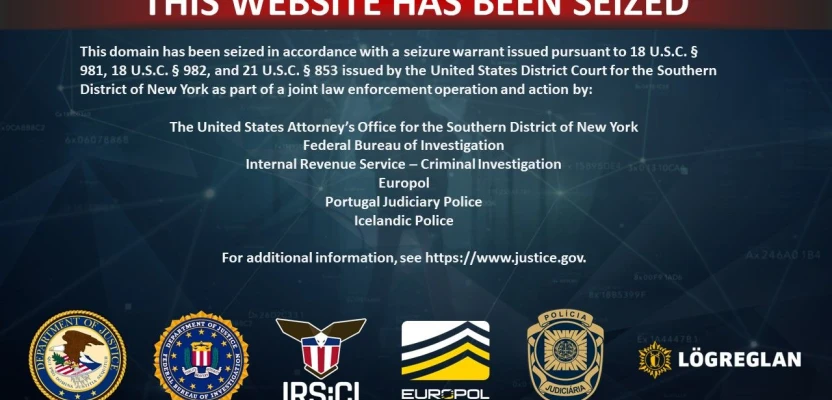
In late April 2024, federal authorities moved against two of the most prominent figures behind Samourai Wallet, a Bitcoin application long pitched as one of the strongest privacy-preserving tools in the crypto space. Keonne Rodriguez, the chief executive, and William Lonergan Hill, the chief technology officer, were charged with conspiracy to operate an unlicensed money-transmitting service and conspiracy to launder money. According to a federal indictment, the pair built and maintained a platform that investigators say processed more than $2 billion in transactions tied to unlawful activity, converting a tool marketed for personal financial discretion into, in prosecutors' assessment, a conduit for criminal proceeds.
What the Indictment Alleges
The core accusation is straightforward in outline if enormous in scale. Prosecutors contend that Samourai operated a money-transmission business without obtaining the licenses federal law requires, accepting and moving funds on behalf of users while collecting fees for the service. That activity alone triggered the unlicensed transmitter charge, which carries heavy penalties for companies that handle value without registering with FinCEN or complying with anti-money-laundering obligations.
The second count concerns money laundering. Investigators allege that the wallet deliberately helped conceal the origins of funds earned through illegal markets and scam operations, moving well over $100 million in criminal proceeds through its services. Rather than merely offering generic privacy features, the government argues the platform was engineered to obscure fund flows at the scale and with the intent that characterize laundering infrastructure.
Whirlpool, Ricochet, and the Architecture of Mixing
Two specific products figure centrally in the case. Whirlpool was Samourai's flagship coin-mixing feature: it pooled transactions from many users into standardized outputs, severing the on-chain link between a deposit and its destination. To the project's supporters, this was simply cryptographic privacy applied to Bitcoin. To investigators, it was a tool purpose-built for breaking the audit trail that blockchain analysis depends on.
Ricochet added a second layer. Rather than relying on a third-party mixer, it coordinated transactions among users so that funds arrived from addresses unrelated to the sender's own wallet. Between Whirlpool and Ricochet, the government contends, Samourai offered what amounted to a private laundering pipeline packaged in a consumer-friendly interface. Both features drew directly on the wallet's centralized backend, a detail that would become crucial to the case.
The Decentralization Claim Under Scrutiny
Samourai's public identity rested heavily on the idea that it was not a company in the conventional sense. The founders presented the project as a community-driven protocol, with no user accounts, no know-your-customer checks, and no centralized control over customer funds. Many users chose it precisely because it seemed to sit outside the reach of traditional financial oversight.
The indictment punctured that narrative. Prosecutors describe a centralized server infrastructure that coordinated mixing transactions, managed coordination between users, and effectively gave the operators ongoing control over how the service functioned. If that account is accurate, Samourai was not a trustless protocol but a centrally operated business that chose to ignore licensing and reporting duties while marketing itself as beyond regulation. That gap between branding and architecture is likely to shape how courts evaluate similar privacy projects going forward.
Where the Money Came From
Investigators traced a substantial portion of the activity to darknet marketplaces, including Silk Road and its successor-era successors such as Hydra. These platforms have long been magnets for stolen goods, narcotics sales, and scam proceeds, and their operators have historically leaned on mixing services to cash out without exposing their addresses. Samourai's tools, the government says, made that process faster and harder to trace.
The figures involved are staggering even by crypto-crime standards. With more than $2 billion in allegedly unlawful transactions and over $100 million in laundered criminal proceeds, the case ranks among the largest enforcement actions targeting a privacy-focused wallet. It also illustrates a recurring pattern in digital asset investigations: the same transparency that makes blockchain ledgers auditable also allows analysts to reconstruct criminal flows with remarkable precision, turning what criminals hoped would be anonymous transactions into a detailed evidentiary record.
The Arrests and the Investigation
Keonne Rodriguez was taken into custody in Pennsylvania, where federal agents executed the arrest as part of a coordinated operation. William Lonergan Hill was apprehended in Portugal, and the United States has moved to secure his extradition so he can face charges domestically. The two men are expected to be represented by counsel as proceedings move through the federal system.
The investigation was led by the IRS Criminal Investigation division working alongside the FBI's New York field office, a pairing that reflects how thoroughly tax and financial-crime specialists have become embedded in cryptocurrency enforcement. The IRS-CI's blockchain analytics capability has quietly become one of the most effective tools for tracing illicit crypto flows, and its involvement here underscores that crypto laundering cases are increasingly treated as financial crimes first and technology cases second.
Reports suggest the probe relied on years of transaction analysis, undercover-style monitoring of darknet market activity, and cooperation with international partners given Hill's arrest overseas. The scale of the data involved, billions of dollars moving through a single wallet ecosystem, required substantial forensic resources and illustrates just how methodically US agencies have learned to dismantle crypto crime networks. Each seized transaction record, each mapped wallet cluster, and each subpoenaed server log adds another layer to a case that prosecutors hope will stand up to the scrutiny of a federal courtroom.
What the Charges Mean Legally
If convicted, Rodriguez and Hill each face a maximum sentence of roughly 25 years, though actual outcomes in federal cases depend on sentencing guidelines, cooperation, and the specific counts proven at trial. The unlicensed transmitter charge alone is serious: it signals that providing money-transmission services to the public, even in a decentralized or pseudonymous form, triggers US regulatory obligations that cannot be sidestepped through clever product design.
The money-laundering count raises a more contested question: at what point does a neutral tool become criminal infrastructure? Prosecutors will argue that the features were marketed to, and used overwhelmingly by, actors seeking to hide criminal proceeds. The defense, presumably, will contend that privacy is a legitimate use case and that the founders cannot be held responsible for how every user deployed the technology. How a jury or judge resolves that tension will likely be cited in future cases involving mixers, privacy coins, and self-custody tools.
A Turning Point for Privacy Tools
The Samourai case lands at a moment when the crypto industry is already under intense pressure over privacy features. Regulators in multiple jurisdictions have moved against mixers and high-anonymity coins, compliance demands have pushed exchanges toward stricter monitoring, and the boundary between legitimate financial privacy and facilitation of crime has become one of the most litigated questions in digital asset law.
For developers of privacy-preserving software, the indictment serves as a cautionary blueprint. The features that made Samourai attractive, pooled mixing, coordinated transactions, minimal data collection, also made it easy for criminals to use and easy for investigators to characterize as purpose-built laundering infrastructure. Whether the case produces lasting restrictions on mixing technology or instead clarifies that privacy tools can be lawful when genuinely decentralized and compliant remains an open question, but the precedent it sets will be watched closely by every project in the space.
The Industry Response
Within hours of the arrests, rival wallet projects and privacy advocates began distancing themselves from Samourai's approach while defending the principle of financial privacy more broadly. Several teams rushed to emphasize that their products did not rely on centralized coordination servers, did not charge fees for laundering-adjacent features, and maintained compliance programs or geographic restrictions. The implicit message was clear: the Samourai model, whatever its technical merits, was now radioactive.
At the same time, civil-liberties-minded observers warned against overreach. They argued that criminal misuse of a tool does not automatically make the tool's creators guilty, and that treating privacy software as inherently suspect risks chilling legitimate uses ranging from protecting dissidents to shielding ordinary savers from data brokers. The tension between those two positions, enforcement versus rights, is unlikely to be resolved by this single case, but the Samourai prosecution will undoubtedly be invoked on both sides of every future debate about mixers and anonymous transactions.
The Road Ahead
The next phases will involve extradition proceedings for Hill, pretrial motions, and eventually either a plea agreement or a trial in federal court. Observers will be watching for two things: whether the government can prove the founders knew their platform was being used primarily for criminal purposes, and whether any of the defendants cooperate in ways that expose broader networks of darknet market operators and money launderers.
Whatever the outcome, the arrest of Samourai's leadership marks a watershed moment. It demonstrates that US authorities are willing to treat the operators of privacy tools as money transmitters and launderers when scale and criminal usage cross certain thresholds, and it sends an unmistakable signal to the wider industry: the era of building anonymous financial infrastructure without answering to anyone is effectively over. For the millions of ordinary users who once trusted the app to safeguard their savings, the episode is also a sobering reminder that the software meant to protect them may have been doing something far more dangerous beneath the surface.

Comments 0