

When the dust settled on one of the largest exchange thefts of 2023, the strangest part was not the nine-figure loss itself. It was the invoice. Poloniex, the platform that had just watched roughly $114 million leave its hot wallets, turned around and published terms under which the person responsible could keep $10 million of the haul and walk away. The proposal was not whispered to investigators or buried in a sealed settlement. It was broadcast where the thief lived: on the blockchain.
A Theft That Announced Itself
The breach surfaced in early November 2023, when Poloniex detected abnormal outflows and halted trading while its engineers reconstructed what had happened. Based on the exchange's own account, attackers had found a way into systems connected to the platform's hot wallets, the operational reserve kept online so users can withdraw quickly. Once the drain was confirmed, the exchange moved to contain the damage: services went offline, withdrawals were suspended, and teams began pulling transaction traces.
What made the episode distinctive was the speed and openness of the response. Rather than issuing a boilerplate statement and disappearing into a multi-year investigation, Poloniex treated the stolen assets as a live problem that demanded immediate, visible action. Every movement of the funds, from the first hop out of the compromised wallets to later transfers through mixers and swaps, was being watched by analysts, rival exchanges, and curious onlookers alike.
In crypto, the crime scene is never sealed. The ledger records every address, every amount, every timestamp, and anyone with internet access can replay the theft block by block. That transparency cuts both ways: it gives investigators extraordinary visibility, but it also gives the perpetrator endless time to think, wait, and plan a cash-out that avoids the services most likely to flag him.
Terms Written in Plain Sight
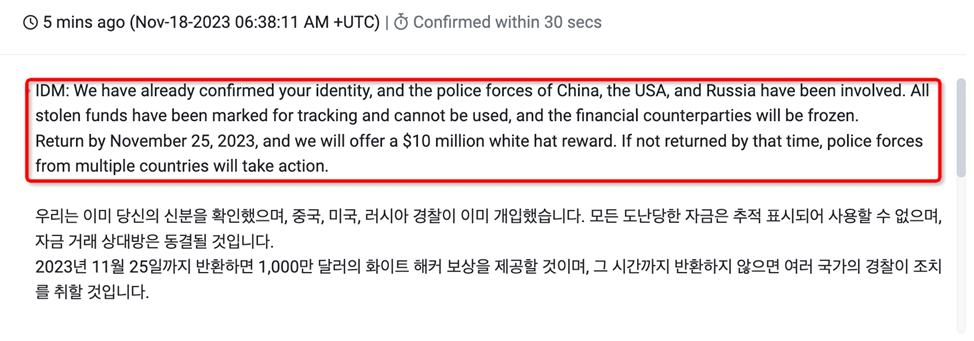
Poloniex communicated with the attacker through a transaction message embedded directly on-chain, a medium chosen for the obvious reason that a person who just stole a fortune in cryptocurrency is most likely to read what appears in their wallet. The notice was delivered in several languages at once, suggesting the exchange suspected the intruder might operate within any of a number of large crypto communities and wanted to eliminate any claim that the offer went unnoticed.
The substance of the deal was blunt. Hand back the stolen assets before the stated cutoff, and the exchange would pay a $10 million reward on top. Do nothing, and the matter would be handed to law enforcement with everything the company had collected. The figure was enormous by ordinary standards and trivial next to the loss: roughly nine percent of what was taken. For an organization staring at a hole that size, buying back most of its own money at a discount was arithmetic, not charity.
Publishing the offer also served a second purpose. By putting the terms where the whole world could read them, Poloniex invited the thief to make a decision under public pressure. Accepting meant revealing himself to claim the reward. Ignoring meant betting that anonymity plus patience would protect him better than a payout. Either choice told the exchange, and the market, something useful.
A Deadline Nobody Met
The window closed in late November 2023, and no credible report ever confirmed that the attacker accepted the arrangement. Silence is itself informative. It suggests either that the funds had already been dispersed in ways that made a single clean return impractical, or that even $10 million was not enough compensation for the exposure inherent in repaying a theft.
After the deadline passed, Poloniex did not escalate theatrically. The exchange continued pursuing recovery through conventional means: forensic analysis of the fund flows, cooperation with police agencies, and coordination with other platforms that might encounter the tainted coins. Investigators in multiple jurisdictions reportedly took interest, though, as with most headline crypto thefts, publicly confirmed progress has been limited.
Meanwhile, the stolen assets remained part of the permanent public record. Analysts continue to track the addresses, flag attempts to route value through decentralized exchanges, bridges, and privacy-enhancing tools, and watch for any wallet that behaves like it might belong to the original thief. The trail may never lead to an arrest, but it will never disappear either.
The Field of Competing Offers
Poloniex was far from the only party trying to shape the outcome. Justin Sun, one of crypto's most visible figures, publicly offered the thief 5 percent of the stolen value, approximately $5.7 million, for a voluntary return. His proposal, like the exchange's, produced no visible acceptance, yet it illustrated how the incident had spawned a crowd-sourced hunt for resolution.
Elsewhere in the ecosystem, bounties of different shapes were in circulation. Figures connected to earlier hacks had dangled rewards for information about perpetrators, including offers denominated in tokens tied to other thefts. The result was an informal economy of incentives: victims posting rewards, outside parties posting their own, and a global audience of sleuths scanning wallet activity for clues that might translate into a payday.
This patchwork response is becoming the norm rather than the exception. When a major exchange is drained, the official investigation is only one thread in a much larger web. Community researchers, rival platforms, token issuers, and opportunists all have reasons to care, and all of them can influence what happens next, whether by freezing deposits, sharing intelligence, or simply posting theories that shape the narrative.
Should Criminals Get Paid to Stop?
The ethical objection writes itself: rewarding theft invites imitation. If every hacker can demand a cut for returning what was never theirs, the argument goes, the incentive structure of the entire ecosystem inverts. Poloniex's position rested on a narrower calculation. The payment was conditional on full restitution, capped at a fraction of the damage, and premised on the reality that unrecovered crypto is often unrecoverable at all.
There is also a legal nuance worth noting. The offer was not framed as a ransom or an ongoing extortion; it was a one-time bounty for reversing the crime, with no immunity guaranteed beyond what an exchange can actually deliver. Whether prosecutors would honor such arrangements is uncertain, but the framing mattered, because it distinguished negotiation from coercion.
For ordinary users, the deeper takeaway was less exotic. No platform, however established, is immune to catastrophic failure, and the distance between marketing assurances and a nine-figure hole in the balance sheet can be measured in a single bad week. Custody risk is not a hypothetical; it is a line item that shows up on a blockchain exactly when things go wrong.
Recovery as a Grind, Not an Event
In the months following the deadline, the public story of the Poloniex hack has remained deliberately low-key. No dramatic arrest, no definitive attribution, no confirmed recovery of the bulk of the funds. That is typical. Tracing stolen crypto is slow work measured in years, complicated by jurisdictional boundaries, privacy tools, and the simple fact that a determined holder can wait out the attention before attempting to spend.
The structural response, however, has been anything but quiet. The industry has spent the period since tightening the very systems that failed: shrinking or eliminating hot wallets, expanding insurance and reserve transparency, and treating exchange security as an ongoing operational discipline rather than a feature you advertise once. The lesson of cases like this one is that there is no permanent fix, only better odds.
Law enforcement has adapted too. Blockchain analytics is now a routine investigative tool, and tainted funds are routinely frozen the moment they touch a compliant service. The thief's real obstacle is not the theft itself but the endgame: converting stolen value into spendable money without tripping an alarm somewhere in the chain of custody.
What Survived the Headlines
Poloniex absorbed the hit and kept trading, which is itself a verdict on how resilient centralized exchanges can be when they manage the aftermath competently. The company faced regulatory pressure and competitive strain before the breach, and the theft threatened to accelerate user flight. Its response, combining visible containment, transparent communication, and the unusual bounty play, appears to have stabilized operations even if it could not restore the lost funds.
The reputational cost is permanent, though. In crypto, a single headline defines a brand for years, and "the exchange that got robbed" tends to stick longer than any subsequent record of improvement. That is the paradox of crisis management in this industry: you can survive the incident operationally while remaining branded by it forever.
An Open Ledger, an Open Question
The Poloniex saga captures something fundamental about crime on public blockchains. There is no sealed negotiation room, only messages readable by anyone. There is no anonymous room service for stolen goods, only addresses that every analyst on earth can monitor. And there is no certainty of closure, only probabilities playing out in public view.
Whether the thief accepted the $10 million may never be fully resolved. What is already certain is that bounties have become a standard feature of crypto heists, that every future breach will attract a swarm of investigators, rivals, and opportunists, and that the ledger itself is the most patient witness of all.
In the end, the episode demonstrated that on an open ledger nothing stays hidden indefinitely. Every transfer is permanent, every pattern is analyzable, and every would-be profiteer, criminal or victim alike, must reckon with a simple truth: the chain remembers everything, and eventually, someone always comes looking for the money.

Comments 0