
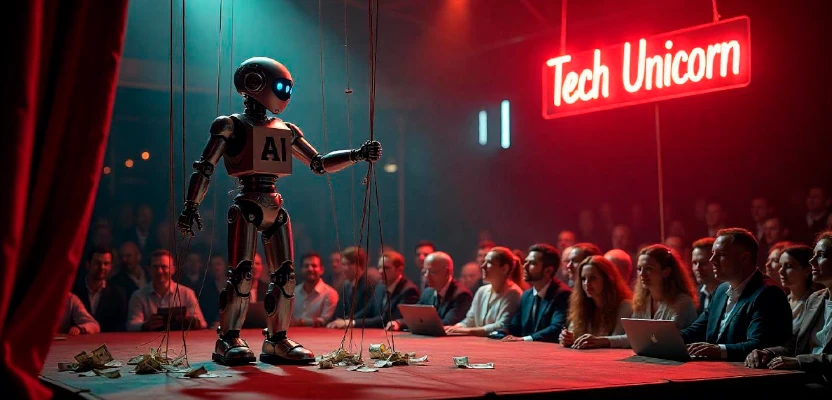
When venture investors poured roughly forty million dollars into Nate, Inc. after its 2018 founding, they believed they were bankrolling the next chapter of automated commerce. The vision sounded effortless: open a mobile app, tap once, and software would handle the entire purchase — comparing prices, navigating checkout forms, choosing the right size, and confirming the order across thousands of online retailers without a person ever touching a keyboard. By the spring of 2025, that story had been dismantled in federal court filings. Albert Saniger, the company's founder and chief executive, was indicted on securities fraud and wire fraud charges after prosecutors concluded he had sold investors an artificial-intelligence venture whose celebrated technology was, in large part, a carefully concealed workforce of underpaid humans.
A Pitch Built Entirely on Automation
The company's appeal was simplicity. Nate marketed itself as an AI-powered shopping assistant capable of completing transactions on essentially any store with a single click — no account creation, no repeated data entry, no fiddling with sizes or shipping options. For consumers, the promise was convenience. For investors, it was something far more valuable: a defensible technology company sitting directly on the explosive growth curve of artificial intelligence.
That positioning landed at precisely the right moment. Throughout the late 2010s and early 2020s, funding rounds for anything described as machine learning or AI swelled dramatically, and diligence often lagged behind enthusiasm. Few backers had either the expertise or the appetite to interrogate what was happening inside a startup's backend. Nate offered a polished product, a confident founder, and a narrative that fit the era perfectly, and the capital followed.
How Nate Said Its Technology Worked
Publicly, the company described a layered system of proprietary software. Natural-language processing would interpret what a user wanted. Recommendation engines would surface relevant products. Browser automation and decision-making models would carry out the transaction itself, end to end, with minimal human involvement. To outside observers — customers, partners, and especially investors — this was a textbook software business with an AI engine at its core.
The reality was considerably less automated than the marketing suggested. Behind the app's smooth interface sat a team of purchasing assistants who did the hands-on work themselves: browsing stores manually, selecting sizes, typing in customer and payment details, and finalizing orders one transaction at a time. These workers, many of them based in the Philippines, were the operational backbone of a product the company presented as largely self-running.
Scaling a Story, Not a System
What made the arrangement workable for Nate was precisely what made it indefensible for investors. A genuine AI platform scales by adding computing power and refining models; this one scaled by hiring more people and paying them wages. Every new customer meant more manual transactions, more assistants to train, and more opportunities for the gap between the advertised technology and the actual workflow to widen. The company's growth, in other words, was evidence against its own pitch — a contradiction that only held together as long as nobody examined the operations closely.
The economics compounded the deception. Software margins are the foundation of startup valuations, and investors had priced Nate accordingly. Replacing those margins with labor costs should have collapsed the thesis on its own. Instead, the true cost structure stayed hidden beneath layers of secrecy and misdirection, allowing the company to keep raising capital against a business that was, in substance, something quite different from what its backers thought they owned.
The Workforce Nobody Was Supposed to See
Investigators and later reporting established that Nate employed hundreds of these assistants to fulfill what the company claimed its algorithms handled. The labor was routine and demanding — the kind of repetitive digital piecework that software is supposed to eliminate — yet it was also poorly compensated relative to the value it generated. For the investors who had funded the company, the existence of this workforce at this scale directly contradicted the central premise of their investment thesis.
The arrangement grew more strained during peak shopping periods. Holiday rushes pushed order volumes beyond what the staff could comfortably manage, and the company reportedly resorted to crude stopgap measures — internally dismissed as "dumb bots" — to siphon off some of the load. Even this fallback was a far cry from the sophisticated automation Nate had promised its backers.
Managing the Secret
Keeping the human workforce hidden required active effort, and the indictment alleged that Saniger personally directed much of it. Performance data that might have revealed how much manual labor the operation depended on was allegedly concealed from investors and staff alike. When workers asked pointed questions about the nature of the technology or the company's real capabilities, they were deflected behind claims of trade-secret protection, a convenient shield that discouraged scrutiny while saying nothing substantive.
Inside the company, employees were reportedly kept in the dark about what the business actually was and how it made money. Some were led to believe their roles were something other than what they were — contributing to an environment where honest questions carried risk and disclosure felt dangerous. The secrecy was not incidental to the fraud; it was the mechanism that allowed it to continue.
How the Illusion Unraveled
The scheme survived on the assumption that nobody would look too closely. That assumption proved wrong. Whistleblowers came forward with accounts of the company's true operations, and inconsistencies began to surface between Nate's public claims and what employees, contractors, and outside observers could actually see. An operation supposedly powered by advanced AI does not, in reality, depend on hundreds of low-wage workers clicking through retail websites, and the gap between those two pictures was too large to explain away.
As the discrepancies accumulated, prosecutors assembled a case built on a straightforward theory: investors had been deliberately misled about the nature of the company's technology and, by extension, about the value of their stakes. What began as startup hype hardened into an alleged pattern of deception — one in which the founder used the credibility of the AI boom as cover for a business model he knew did not match the story he was telling.
The Indictment and What It Alleged
In April 2025, federal prosecutors unsealed charges against Albert Saniger accusing him of securities fraud and wire fraud, offenses that together carry a potential penalty of up to forty years in prison. The government's framing was unusually blunt. Prosecutors described the conduct as exploiting the promise and allure of artificial intelligence to construct a false narrative about innovation — one that, in their telling, never existed in any meaningful sense.
The charges matter beyond Saniger's personal exposure. Securities fraud requires more than optimism or exaggeration; it requires knowingly false statements made to induce investment. By charging Saniger rather than merely criticizing him, the government signaled its view that this was not a case of a founder overselling a rough product, but of deliberate misrepresentation at the center of a fundraising operation.
Why This Case Resonates Far Beyond One Startup
Nate's collapse lands in an industry already struggling with credibility. Every exposed fake-AI venture makes it harder for legitimate startups to raise capital, because investors can no longer assume that a slick demo and an AI-branded pitch reflect real engineering. Due diligence that once focused on market size and growth projections now has to ask a more uncomfortable question: what is the software actually doing, and who is actually doing it?
The phrase "we use AI" has drifted toward meaninglessness in pitch decks across the ecosystem, applied to everything from genuine machine-learning pipelines to glorified outsourcing arrangements. Nate is the cautionary example that keeps resurfacing in that debate — a reminder that in a market where AI language is cheap, the only reliable test is whether the claimed technology survives direct scrutiny. Verify the demo, not the deck.
Lessons for Founders, Investors, and the Workers Themselves
For entrepreneurs, the case illustrates a trap that enthusiasm can set: once a company builds its valuation on a specific technical claim, it faces enormous pressure to maintain the fiction rather than correct it. Every round of funding deepens the hole. For investors, Nate underscores the value of operational diligence — talking to customers, examining hiring patterns, questioning unit economics — over relying on founder charisma and category hype.
There is also a human dimension that the fraud framing can obscure. Hundreds of workers performed the actual labor while being kept ignorant of what the product truly was, paid far below the value their work created for a company valued in the tens of millions. Their treatment is a reminder that behind every abstraction marketed as automation there may be people whose work is being disguised, undervalued, or exploited — and that the line between innovative software and rebranded manual labor is often thinner than a pitch deck suggests.
Where Things Stand
The prosecution of Albert Saniger remains a developing story, with investors, former employees, and the tech industry all watching how the case unfolds. Whatever the eventual outcome, Nate has already secured a place in the growing catalog of cautionary tales about artificial intelligence — one in which the most advanced technology in the building turned out to be the story itself.
Its lasting contribution may be less about one founder's downfall than about a broader warning: in an era when "AI-powered" has become the most marketable adjective in business, the difference between a breakthrough and a bluff is increasingly measured not by what a company claims, but by what it can actually prove.

Comments 0