
In March 2024, an ordinary internet search quietly unraveled one of Britain's longest-running disappearances. A British police officer fed an old photograph into a free facial-recognition website, and within seconds the software surfaced a man living a double life in Thailand under a stolen identity. He had been missing for nearly three decades, and no amount of conventional policing had ever found him.
A Fugitive With a Plan
Richard Burrows was not an impulsive runaway. Before his flight he had worked as a boarding school housemaster and a scout leader in Britain — roles that gave him trust, access to children, and, ultimately, a record of abuse. By the mid-1990s he faced close to one hundred criminal counts involving child sexual abuse. Freed on bail awaiting trial, he simply vanished days before his hearing was scheduled.
What made the case so hard to close was that Burrows left deliberately prepared. Rather than disappear into obscurity, he constructed a second identity with unusual care. The name he chose belonged to Peter Leslie Smith, a genuinely terminally ill man. Through paperwork obtained using that name, Burrows secured an authentic British passport — a real travel document issued to a real person, but bearing his own face. It was the kind of detail that would let him cross borders, rent apartments, and take jobs for years without raising alarms.
The victims' allegations painted a picture of systematic abuse carried out across multiple institutions during his years of employment. His roles as a housemaster and scout leader had placed him in positions of authority over children, which made the eventual exposure of his crimes all the more damaging to the communities that had trusted him. When he fled, he did not merely avoid prosecution — he severed himself from every thread connecting him to that past.
Twenty-Eight Years in Phuket
Burrows settled in Phuket, Thailand, and rebuilt his life as Peter Smith. He worked as an English teacher, later drifting into media and advertising work. Neighbors and colleagues described a quiet, unremarkable expat — the sort of foreigner Phuket has thousands of. He lived modestly, at one point in a converted shipping container, and made little effort to draw attention to himself.
That low profile worked almost too well. For decades, the man known as Peter Smith was just another face in a resort town full of foreigners. Local journalist Tim Newton, who knew Smith personally, later recalled that nobody in Phuket ever suspected anything unusual. The identity was mundane precisely because it was so ordinary.
Over nearly three decades, the gap between the two lives widened enormously. In Britain, Richard Burrows remained a wanted man whose alleged crimes stayed unresolved; in Thailand, Peter Smith aged into an elderly expat with a teaching and advertising career and no visible connection to his past. He gave interviews as Smith, attended social gatherings, and maintained the kind of settled existence that fugitives dream of — one built entirely on a name borrowed from a dying stranger.
The Search That Never Found Him
Burrows's disappearance left British authorities with an unusually frustrating puzzle. He had been wanted for serious offenses against children, yet he had crossed an ocean, obtained legitimate travel papers, and simply gone quiet. Police issued notices, appeals aired on programs such as BBC Crimewatch, and international channels including Interpol were kept informed. The trail, however, went cold almost immediately and stayed cold for years.
Part of the difficulty was bureaucratic as much as geographical. A man holding a valid British passport under a false-but-genuine identity does not trigger the red flags that a forger using fake documents would. To immigration officers and employers alike, Peter Smith appeared legitimate. The longer the years passed, the more his new life calcified into permanence — until the technology caught up.
Investigators tried the tools available to them. Passport records, travel manifests, and border databases were searched; old photographs were circulated; appeals went out through media channels. Each avenue assumed Burrows would have to slip up — use a name, board a plane, contact a relative. Instead he kept his head down in a country where his fabricated identity was backed by genuine state paperwork, and the paper trail that should have exposed him instead certified him as legitimate.
The Photo That Broke the Case
The breakthrough came from an unexpected direction. A Cheshire Police officer decided to try a consumer-grade facial-recognition service called PimEyes — a website that anyone can use to search the internet for faces matching a photograph. Burrows's police file still contained his decades-old mugshot, and that image became the query.
The results arrived quickly. Among the matches were photographs of an older Peter Smith taken at a 2019 farewell party in Phuket — social media images showing a man who looked unmistakably like the fugitive, just aged. What sealed the identification was a small but distinctive physical mark: a pimple on the neck, visible in both the recent party photos and the original mugshot from 1997. The resemblance was not merely algorithmic; it was anatomical.
Why Facial Recognition Cracked What Police Could Not
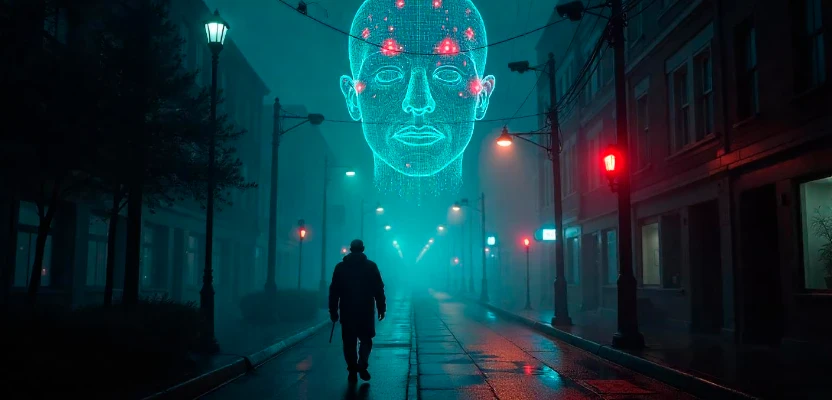
Facial recognition works by reducing a face to mathematical features — the spacing of eyes, the shape of a jaw, the contour of a neck — and then searching enormous collections of images for statistical matches. To a human investigator, a mugshot from 1997 and a party photo from 2019 might look merely similar. To the algorithm, the underlying geometry was close enough to surface the match automatically, pulling the image out of the vast churn of social media where Peter Smith's party photos had been sitting in public view for years.
The case also illustrates how the technology has democratized identification. The decisive search was run on a commercial website, not through an interagency biometric database. The officer who ran it needed nothing more than the old mugshot and an internet connection — a capability once restricted to governments now available to anyone willing to upload a photograph.
A Face, a Flight, and a Heathrow Arrest
Once the identification was confirmed, the investigation moved fast. Burrows, now elderly and reportedly homesick and financially strained after nearly three decades abroad, made a decision that sealed his fate: he booked a flight to London. He may have hoped that distance and time had buried his past, or simply wanted to spend his final years near home.
He never made it past the gate. Officers were waiting for him at Heathrow Airport in March 2024. The arrest ended a manhunt that had outlasted careers, governments, and generations of investigators — accomplished, in the end, not by a global dragnet but by a single photograph uploaded to a public website.
Justice After Nearly Thirty Years
The legal reckoning unfolded slowly but conclusively. Burrows, then 81 years old, faced the charges arising from his 1990s offenses. In 2025 he was convicted on 97 counts of child sexual abuse — a slightly narrower total than the original allegations, but enough to establish guilt beyond doubt. The court sentenced him to 46 years in prison.
For victims who had waited decades, many having assumed the case would never be resolved, the conviction carried weight far beyond the prison term. Survivors finally saw their allegations tested in open court and their alleged perpetrator held accountable — an outcome that had seemed impossible while he lived anonymously in Thailand.
A Tool for Good and a Tool for Everyone
Burrows's capture is frequently cited as a triumph of artificial intelligence in policing, and in one sense it plainly was. A technology once associated with surveillance states had located a fugitive that traditional methods could not. But the details of the case also expose its unsettling edge: the decisive tool was not a police-exclusive system with oversight and warrants, but a commercial website open to any user with a photograph.
PimEyes operates outside most of the regulatory frameworks governing law-enforcement facial recognition. Anyone can upload an image and search the web for matches, raising obvious questions about consent, accuracy, and misuse. In Burrows's case the outcome was justice. The same capability applied differently could target innocent people, enabling stalking, harassment, or wrongful identification at scale.
Who Watches the Watchers?
The privacy concerns are not hypothetical. London police have reportedly run thousands of PimEyes searches in short periods — figures cited in reporting put the number above 2,000 lookups in roughly 90 days — and civil liberties organizations have pushed for restrictions on how such tools are used. The debate cuts both ways: facial recognition demonstrably catches people who have evaded justice for decades, yet it also builds infrastructure for mass identification of private citizens who have done nothing wrong.
Burrows's case forces a question that has no comfortable answer. When a single uploaded photograph can locate someone hiding for thirty years, the same photograph can locate anyone. The technology that ended his escape may be exactly what makes the next fugitive's — or any citizen's — privacy far harder to protect. Whether society can keep the former benefit while containing the latter risk remains genuinely unresolved.
Twenty-eight years, two continents, and a fake passport ultimately ended with a selfie-era tool and a birthmark-sized clue. For the victims of his crimes, justice finally arrived — late, but real. For everyone else, the case stands as an early, vivid example of how thoroughly facial recognition has changed the meaning of simply being seen.

Comments 0